

In an industry often associated with storytelling, media relations, and visibility, Mrinall Dey believes the real work of communications lies elsewhere: in shaping meaning, managing consequences, and telling leaders what they need to hear rather than what they want to hear. His journey into public relations was anything but planned. A chance visit to a PR agency in 1998 sparked a curiosity that eventually led him from the newsroom of Press Trust of India to leadership roles in corporate communications and, today, to advising organisations as a Fractional Communications Advisor.
Over nearly three decades, Dey has witnessed the transformation of public relations from a media-centric function to a strategic business discipline that sits at the intersection of reputation, risk, and leadership. In this conversation, he reflects on the pivotal moments that shaped his career, the lessons learned from difficult decisions, the misconceptions that continue to surround the profession, and why the future of communications will belong to those who can think in consequences rather than content.
Edited Excerpts:
Q: How did your journey in PR begin? Was it a conscious career choice or something you attribute to chance? Did your parents understand and support your decision at the time?
Pure chance. 1998. I was a sub-editor at Press Trust of India, waiting in a friend's office at LinOpinion while he finished a client call. I had walked in expecting to kill ten minutes. I ended up staying two hours.
One colleague was drafting a press release. Another was pitching a story to a journalist I had dealt with the week before from the other side of the phone. A third was calmly absorbing a client who clearly wanted the moon by Friday. The room had a specific kind of energy. Fast, opinionated, creative, and patient all at once. I hadn't seen anything like it in a newsroom.
I walked out knowing I would do this eventually. It took me six more years. I finally made the jump in 2004, joining Bharti Airtel in Mumbai as a Corporate Communications Manager.
My parents? They were confused. In a middle-class Indian household in the late '90s, journalism was already an eccentric career. Public Relations needed an explanation I didn't have the vocabulary for. What settled it for them was not my argument. It was the work. Once they saw the stories I was helping shape, and the companies I was doing it for, the scepticism quietly went away.
Chance opened the door. Conviction kept me there.
Q: What would you consider your defining moment or breakthrough in the industry?
Not an award. Not a campaign. A conversation.
Early in my career, a serious allegation was raised against a senior leader. The instruction from the top was familiar. Make it go away. Keep the organisation's name out of it.
I said no.
I argued that we had to face it directly. Acknowledge the complaint, investigate it, act on the findings, and let the organisation be seen for what it chose to do, not what it chose to hide. It was not a comfortable position. I held it anyway.
The organisation took the harder road. The story that emerged was not about cover-up. It was about accountability. The reputation, in the long run, was stronger for it.
That is the moment I stopped describing myself as a press release writer. I became an advisor. Someone in the room when the hard calls are being made, whose job is to tell the leadership what they need to hear, not what they want to hear.
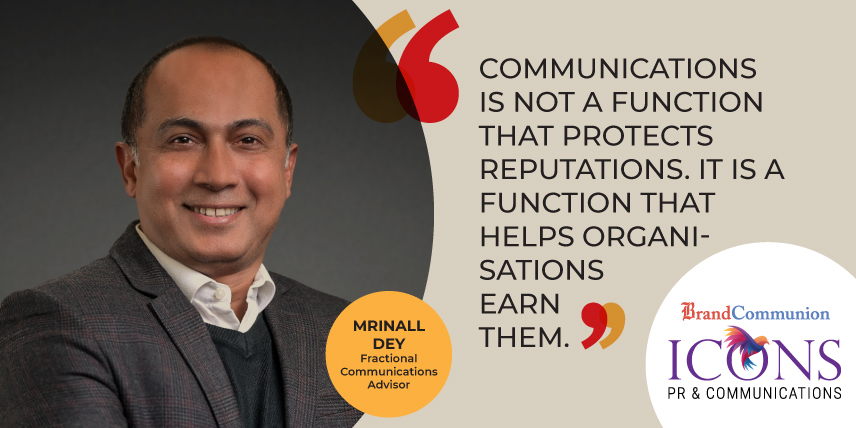
Communications is not a function that protects reputations. It is a function that helps organisations earn them. Every piece of work I have done since has been an extension of that single realisation.
Q: Can you tell us about the toughest phase in your career, and what that period taught you?
The toughest phases are never the public crises. Those you can fight. The harder ones are quiet. You are in a room, arguing for the right call, and the room is not listening.
There was a stretch where I was advising leadership through a situation with strategic, legal, and reputational consequences all tangled together. My reading was clear. The room's reading was convenient. I pushed. I was overruled. I watched the outcome unfold exactly as I had warned it would.
Being right is not the same as winning. That period taught me three things.
One. Your job is to put the uncomfortable truth on the table, with evidence, with precision, with composure. What the leadership does with it is their call, not yours.
Two. Credibility is built in the rooms where you say no.
Three. Stay. Do not resign every time you are overruled. Change the thinking from the inside. It is slower, but it lasts.
I carry those lessons into my consultant mode. When a client asks me to help hide something, I do not lecture. I show them the cost of hiding it versus the cost of owning it. Most choose right.
Q: How have you seen PR evolve from when you started to today's digital-first world? What are some key changes that stand out to you?
Three shifts stand out. The rest is noise dressed up as transformation.
First, the audience stopped waiting. In 1998, a story broke when the newspaper hit the stands the next morning. Today it breaks the moment a screenshot leaves a WhatsApp group. The window for a considered response has collapsed from hours to minutes. That has not made communication faster. It has made judgment more expensive.
Second, measurement finally got serious, and then got lazy again. We used to count column centimetres. Then we counted AVEs, which everyone secretly knew was nonsense. Then we started counting share of voice, which sounds better but is still a volume metric pretending to be an impact metric. The real question has always been the same. Did the communication move the business, shift perception, protect reputation, or influence decision? The industry is still uncomfortable answering that honestly.
Third, the journalist is no longer the only gatekeeper. The LinkedIn post from a CEO, the thread from an analyst, the creator video from an influencer. These move narratives as powerfully as a front-page story used to. Good. But the core craft has not changed. You still need to understand the audience, tell the truth, and respect the reader.
What has stayed the same is the part people keep forgetting. Communication is not about saying more things. It is about shaping meaning for a specific audience, in a specific context, for a specific outcome. The tools have multiplied. The discipline has not.
Q: What is one piece of advice you would give to someone just entering the PR industry? And if given the chance, would you still choose a career in PR today?
Learn to think in consequences, not content.
Most young professionals are trained to ask, what should we say? The seniors I respect ask, what will happen if we say this, to whom, in what order, with what second-order effects? That shift, from content to consequence, is what separates the executor from the advisor. Start practicing it from day one. Ask why before you ask what. Ask who before you ask how. Ask what happens next before you press send.
Two more. Read widely. Not just comms publications. History, business, politics, culture. Good communicators carry a mental model of how the world actually moves. And stay close to journalists, not as a transaction but as a craft relationship. They will sharpen your thinking faster than any training programme.
Would I do it again? Yes. Without hesitation.
The work is harder than it looks and less glamorous than it sounds. You will spend years being underestimated, then a decade being overestimated, and the last stretch being taken seriously. But you will also sit in rooms where you quietly change the course of an organisation, where you stop something bad from happening, where you help someone tell a truer version of their story.
That is not a bad way to spend a career. That is exactly how I would want to spend another one.
Q: What is one common misconception about PR that you would like to correct?
That PR is about storytelling.
It sounds sophisticated. It gets repeated on every panel. And it is incomplete to the point of being misleading.
Storytelling is a tool. It is not the job. A good story badly timed, aimed at the wrong audience, landing in the wrong context, will hurt you more than silence would. A weak story, told to the right person at the right moment with the right evidence, can shift an entire narrative.
The actual job is consequence management through language. You study the organisation, its positives, its negatives. You study the sector and the competition. You understand what conversation is already happening in the market. You figure out what your client genuinely stands for, not the tagline version, the real version. Then, and only then, you decide what to say, to whom, how, and when.
The other tired misconception. That this is a business of wining and dining journalists. It never was. That was the cosmetic layer. The real work was always the thinking behind the pitch, the framing behind the quote, the judgment behind the release. The professionals who mistook lunch for strategy are the ones who did not last.
PR is not storytelling. It is meaning-making, with measurable consequence. Get that right, and the stories write themselves.
Q: Where do you see the PR industry heading in the next five years?
Three directions. Not predictions. Trajectories already in motion.
One. The function will finally get a seat at the strategy table, or it will be reduced to a service desk. There is no middle path left. The organisations that treat communications as a core function, sitting on risk, reputation, narrative, and leadership positioning, will build durable brands. The ones that keep treating it as a cost centre will keep paying the reputation tax and wondering why.
Two. Measurement will stop pretending. Share of voice, AVEs, impression counts. These have had a long run. Clients are starting to ask the harder question. Did the communication move the business? Did it protect the licence to operate? Did it make the sales conversation easier? Those who can answer with evidence will lead. Those still sending coverage reports will be quietly replaced.
Three. AI will redraw the workflow, but not the judgment. AI will take over the drafting, the monitoring, the first-cut research, the sentiment tracking. Good. It should. What it will not do is tell you when to speak, when to stay quiet, which truth to lead with, and which fight not to pick. Those are advisory calls. They sit with humans who have seen enough to know the difference.
The professionals who will matter most in 2031 are the ones who can use the new tools, ignore the hype around them, and still think in consequences.
Q: If your PR journey had a headline, what would it be?
"From the Newsroom to the Boardroom. Still Asking the Questions Nobody Else Will."