

Public relations has long been mistaken for a function measured in headlines and press mentions. But for one veteran communications leader, that definition never quite held up. Across roles spanning journalism, global corporates, and large-scale brand building, the work has steadily shifted away from visibility metrics toward something sharper: solving business problems through narrative clarity.
In this conversation, Minari Shah, Brand Strategy & Communications Consultant, traces an unconventional journey into PR, the moments that redefined their understanding of the craft, and the tough early years that shaped their approach. From Dell to Amazon, from media relations to boardroom strategy, the evolution of communications emerges not as a gradual shift, but as a fundamental rewrite of what the function is meant to do.
Edited Excerpts:
Q: How did your journey in PR begin? Was it a conscious career choice or something you attribute to chance? Did your parents understand and support your decision at the time?
Largely a chance. The intentional part came later.
I started out as a copywriter in Chennai in 1993, then moved into business journalism through the latter half of the '90s at The Hindu Business Line and Business India. PR initially happened due to the financial need, when the publication I was with began delaying payment in the tech downturn at the turn of the millennium. I was young, the move was easy enough though I didn’t back then have any strong opinions about the craft I was walking into.
By then I was just turning 30, so it wasn’t something where I needed my parents’ approval but they were anyway the kind who had taught me to make my own decisions, and then to live with them. They had backed my UPSC preparation when I wanted to sit for civil services. They backed my choice to walk away from it after qualifying initial rounds. When I took a two-year sabbatical to try my hand at film writing, they watched it with curiosity and amusement above all else.
Q: Did they or anyone in friends & family fully understand what public relations was in those early years?
Probably not. Very few people outside the business do even today. But the support was never a question. If I had a point of view, my family trusted that I had thought it through.
Q: What would you consider your defining moment or breakthrough in the industry?
If I had to pick one, it would be internal. A realisation, sometime in my second corporate communications role, that I had been doing the job from the wrong position.
I had been treating communications as a support function. Something that helped the business after the important decisions were already made. What changed was learning to see it very differently, as something that had to be present while the decisions were still forming, with the standing to shape them.
If I have to answer your question in a more traditional perspective, I think joining Dell became a breakthrough moment.
For one, I almost got sidestepped when a bigger opportunity came up within the company – I was told I was seen as competent but as someone that stayed too much in my own lane. It was a reminder from my previous learning that I had to grow my role, I had to experiment and innovate. I stepped up, the bigger role became mine, I never looked back. Working not just with a global top 100 brand but also with some amazing business leaders and comms managers globally was fantastic learning, giving me my first opportunity to launch a global campaign from India.
Once that clicked, the rest of the work took its shape from it. Launching Take Your Own Path first in India at Dell, building DWEN globally, the design and EV repositioning at Tata Motors, shaping Amazon as a brand in India with marquee campaigns like Smbhav and the Great Indian Festival at Amazon, all followed from that reframe. They are what the early discipline made possible later.
One thing I've noticed across ever since: business leaders are almost always willing to listen. The question is what we bring to the conversation. Tactical asks rarely get a second meeting. A sharp read of the business problem almost always does.
Q: Can you tell us about the toughest phase in your career, and what that period taught you?
It was in the early years, among my first multinational corporate PR roles after journalism. I had landed in a strongly sales-driven B2B company where communications was handled as overhead, something you did when you had time left over from the revenue work. The job kept being pushed to the edge. It was a slow grinding sense, more than any single bad stretch, that the work wasn't being taken seriously, and that I couldn't see how it connected to anything that actually moved the business. I got quite despondent for a while.
What eventually pulled me out was accepting something uncomfortable. That I had to change where I was starting, what I was going to do. The marginalisation was architectural and not about me but I was the one that would need to change it. I went up to the MD, and we began to rewrite what my role would be, to solve real business problems. It was India specific and meant getting the global leaders aligned to it, to calibrating the global voice for the India situation. I sat into sales meetings and understood product roadmaps as RFP writing teams did.
Later phases have been hard in different ways. The Amazon years had their share of complex policy and reputational stretches, at scale. Those felt very different though, because by then I had the equipment for them, I was getting the opportunity to apply my previous learnings to solve hard situations while continuing to innovate, do new things with larger teams, bigger impact, higher stakes. The early phase was harder because I was still figuring out what the equipment needed to be. But I could not have done Amazon without the previous journey, each role teaching me more.
Q: How have you seen PR evolve from when you started to today's digital-first world? What are some key changes that stand out to you?
Dramatically, and unevenly. The unevenness is the part I'd stress more.
The clearest change is what the job now covers. When I started, PR meant media relations with a bit of event management on the side. A modern communications function sits across policy work, internal communications, social, owned channels, influencer engagement, investor narratives, crisis playbooks, reputation analytics, executive positioning. Almost every public-facing decision a company makes runs through it somewhere.
The second is how audiences now find content. Media credibility is at a historic low. Social reach is pay-to-play. Algorithms decide visibility, platforms come and go, and younger audiences find news through formats that didn't exist 10 years ago. The earned, owned, and paid mix needs constant rebalancing for almost every company I work with.
The third is institutional. In the companies that have caught up, PR reports to the CEO, sits in real leadership conversations, and is measured against business outcomes. Compared to where the function was 20 years ago, that is serious progress.
Then the unevenness. Especially in India, sophisticated practice sits next to methods that should have died a decade ago. Teams still using ad-value equivalency as proof of impact exist alongside teams running proper perception analytics.
One room has a CMO referring to PR as "the media team". The next has PR sitting with the leadership to weigh in on key business strategy or regulatory challenges. Both are happening at the same time, often in the same industry. This gap is the biggest challenge as it impacts how the industry itself is perceived.
Q: What is one piece of advice you would give to someone just entering the PR industry? And if given the chance, would you still choose a career in PR today?
One piece, above everything else: learn the business the way the business knows itself.
Go past the briefing deck. Read the earnings calls. Understand the profit and loss. Know who the real competition is and why they are winning or losing. Know what is the business-blocker & how can reaching the right message to the right stakeholder help unleash growth.
Most of what you actually use in a campaign is a thin slice of what you need to know underneath. Without the rest of it, you can execute well, but you can't counsel, and counsel is where the real job is. There is nothing to beat the adrenaline of making true impact.
If I'm allowed a second thing, it is reading & being curious. Reading widely, and across fields far outside your industry. A well-read, curious person is a sharper storyteller, but also a more informed and interesting colleague in a meeting. The more of it you do, the faster you'll see vanity PR for what it is, the coverage that feels good but moves nothing, and walk away from it.
Also, the last four years of AI adoption and learning to use it smartly is teaching me how you use AI as the differentiator. And I have learnt that business + domain knowledge as well as ability to bring creative insights, the ability to connect dots (that needs both wide & deep knowledge) is the true differentiator in what one can draw out of the AI tools.
Q: Would I choose PR again today?
Yes. More confidently than I did when I started out.
The function is at its most interesting inflection point in decades. Policy, reputation, employee activism, category-creating narratives: these are business-defining problems, and they sit squarely in our remit. For anyone with curiosity and a bias towards thinking, there are few better places to be right now.
Q: What is one common misconception about PR that you would like to correct?
That it's about coverage. The most stubborn misconception in the business.
Too many people, including senior leaders and many communications professionals, still think of PR as the function that produces media hits, follower counts, and the occasional well-timed press release. We let that framing stick for too long, and it has cost the profession. Media credibility has dropped and social reach now lives or dies by algorithm. The companies that define PR by the channels it manages are defending ground that keeps shrinking under them.
My framing is about narrative clarity for the audiences that matter most to your business: investors, regulators, employees, partners, customers, policymakers. Media is one channel among several, sometimes the right one, at times not.
The craft is in knowing which story needs to move which audience in which direction, and building the right mechanism to get it there.
When that is the anchor, the wrong questions fall away. You stop asking whether the clippings were good enough and start asking whether perception shifted. You stop counting impressions and start tracking whether regulators trust you, whether investors are holding, whether the talent funnel is widening. This allows you to have a harder internal conversation. Also the only one worth having.
Q: Where do you see the PR industry heading in the next five years?
Five years out, four shifts seem likely to me. Some more uncomfortable for the industry to face than others.
First the obvious. AI will reshape the work itself. Budgets, team structures, skill profiles, measurement: all of it will move. The function that avoids the reshaping won't survive it. The one that steps into it ends up more strategic, because the lower-value work becomes cheap and the judgment work becomes more visible. It will also redefine agency-client relationships as AI will move many tasks inhouse and the agencies that survive will be the ones that bring value beyond execution.
Two, the channel mix will keep fragmenting. Traditional media will lose more ground. Social will keep shapeshifting. AI-driven search and discovery will change how audiences find information in ways we are only beginning to read. Communications teams will need to stay light on their feet about where any given message actually travels, and how.
Third - Employee communications will finally come into its own, but this is where there is need for sharp redefinition. Everyone nods at its importance but most companies still treat it as an add-on, squeezed into limited time by the comms leader (or indeed business leadership) and often ticking boxes for delivering information that does not move employee perception, is not measured in terms of CTRs or actual pageviews/ readership/ viewership. Global conflicts, emerging technologies, generational cultural shifts all mean that unless companies recognize the need for getting this right, they will realize the damage too late.
The fourth is the biggest, the one I keep turning over. Reputation damage seems to be carrying less weight than it used to. Scandals break, statements get issued, news cycles flare briefly, and the business more or less carries on.
If reputation no longer reliably enforces accountability, the premise of the function needs a fresh answer about what exactly we are stewarding. I am seeing newer ways of defining reputation and this I think will change quite a lot in coming years.
Q: If your PR journey had a headline, what would it be?
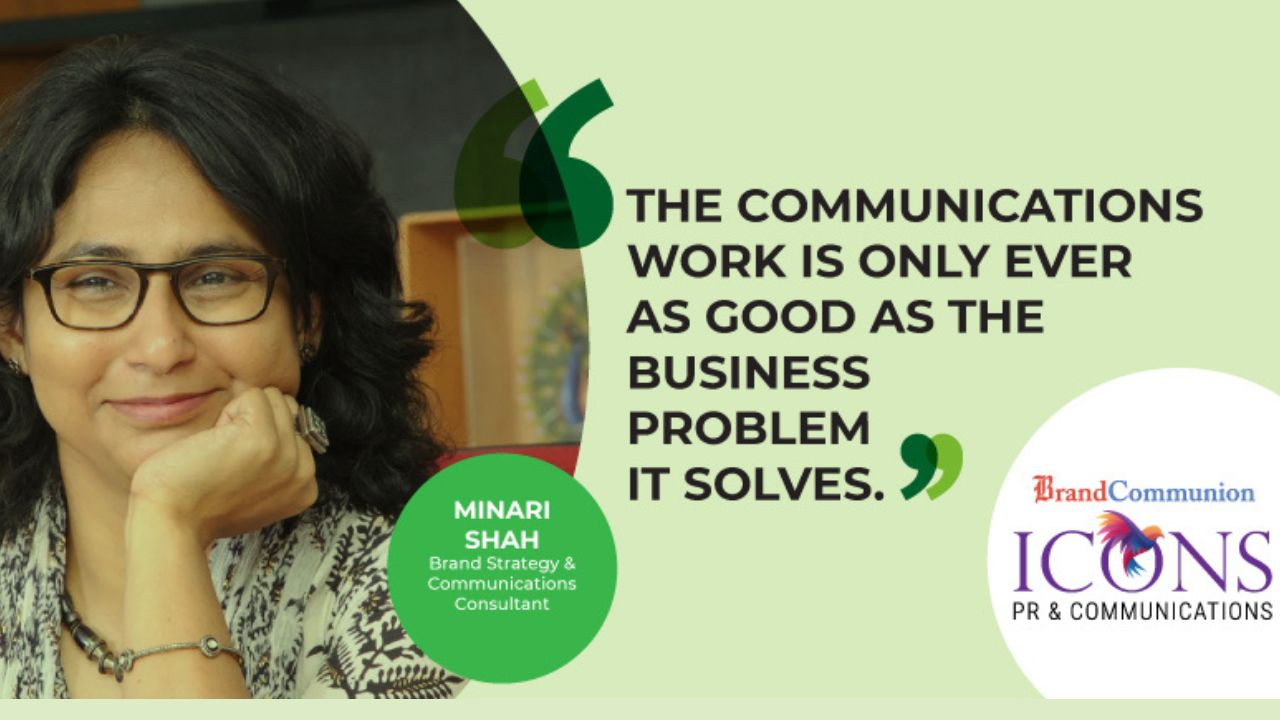
Something like: "The communications work is only ever as good as the business problem it solves."
That thread ran through every role, from Dell to Tata Motors to HSBC to Amazon, and it carries on in the consulting practice now. The work that mattered was the work that moved a business problem forward. Coverage, visibility, clever execution were useful to the extent they served that end.
If the headline had to be more personal, maybe this: "Showed up, spoke up, stayed curious." Both feel true. One is about the craft. The other is about how the craft gets done.