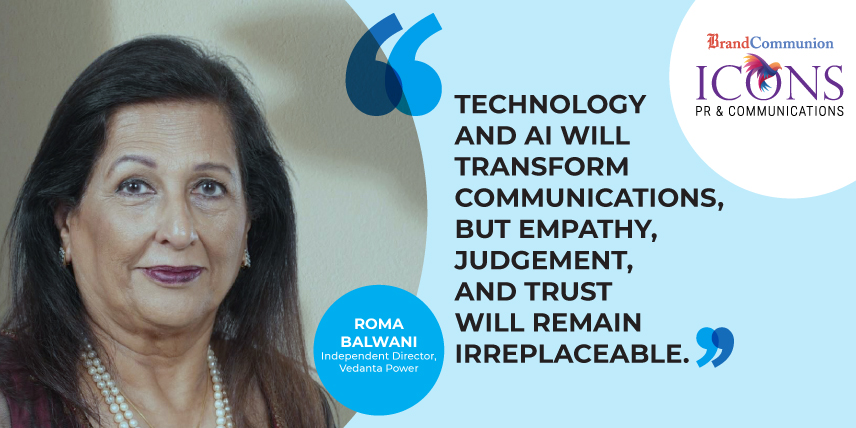


Roma Balwani didn’t begin her professional journey with a roadmap into public relations. What started as a marketing role at Aptech gradually unfolded into a career shaped by storytelling, perception, and the ability to influence how organisations are understood.
Over the years, her path moved through global exposure, leadership responsibilities, and high-pressure moments such as navigating major corporate transitions, each phase reinforcing PR’s role far beyond media relations.
In this conversation, Balwani reflects on how the industry has transformed from a largely press-driven function into a real-time, digital-first ecosystem where data, authenticity, and speed define success.
Edited Excerpts:
Q: How did your journey in PR begin? Was it a conscious career choice or something you attribute to chance?
My journey into PR was a blend of being at the right time & right place and serendipity. I didn’t set out with a plan to enter public relations, my journey in PR began at Aptech when I was in marketing.
I was always drawn to storytelling, people, and the power of perception. Early opportunities allowed me to explore this intersection, and very quickly I realised that PR was not just a profession it was a platform to shape narratives, build trust, and create meaningful impact.
Q: What would you consider your defining moment or breakthrough in the industry?
Rather than a single moment, I see my journey as a series of defining phases. However, stepping into leadership roles where I could influence not just brand reputation but also organisational culture and purpose was truly transformative.
Being able to align communication with larger business strategy and societal impact felt like a breakthrough. My stint in Norway with EBookers, a travel enterprise as a communications specialist, gave me global exposure that shaped my career going forward in Mahindra & Vedanta groups.
Q: Can you tell us about the toughest phase in your career, and what that period taught you?
Like any long career, there have been phases of intense pressure navigating crises, managing transitions, and balancing multiple stakeholder expectations.
One particularly challenging period during the Satyam takeover, reinforced the importance of resilience, patience and clarity.
It taught me that credibility is built not in easy times, but in moments of uncertainty. Staying authentic, calm, and consistent becomes your strongest asset.
Q: How have you seen PR evolve from when you started to today’s digital-first world? What are some key changes that stand out to you?
The evolution has been extraordinary. PR has moved from being largely media-centric to becoming a multi-dimensional, real-time engagement function.
Today, digital platforms have democratised communication, everyone is both a creator and a critic. Speed, transparency, and authenticity are no longer optional; they are essential. Data and analytics now sit alongside storytelling, making PR both an art and a science.
Q: What is one piece of advice you would give to someone just entering the PR industry?
Stay curious and grounded. Build your ability to listen deeply before you communicate. PR is not just about speaking, it’s about understanding context, culture, and people. And most importantly, protect your credibility; it is your most valuable currency.
Q: And if given the chance, would you still choose a career in PR today?
Absolutely. In fact, I believe there has never been a more exciting time to be in PR. The opportunities to influence, engage, and create impact are far greater today than ever before. The Power of Influence is my greatest asset & my favourite mentorship tool.
Q: What is one common misconception about PR that you would like to correct?
That PR is only about managing image or handling crises. In reality, PR is about understanding business goals, enabling peer functions, building trust, shaping long-term reputation, and enabling authentic connections between organisations and their stakeholders & by not working in silos.
Q: Where do you see the PR industry heading in the next five years?
PR will become even more integrated with business strategy. We will see a stronger emphasis on geo-political impact on the corporate sector, so purpose-driven communication, ESG narratives, and responsible storytelling will be the name of the game. Analytics, data science & Technology—especially AI—will play a larger role, but the human element of empathy and judgement will remain irreplaceable.
Q: If your PR journey had a headline, what would it be?
“Build Trust, Shape Narratives, and Lead with Purpose.”