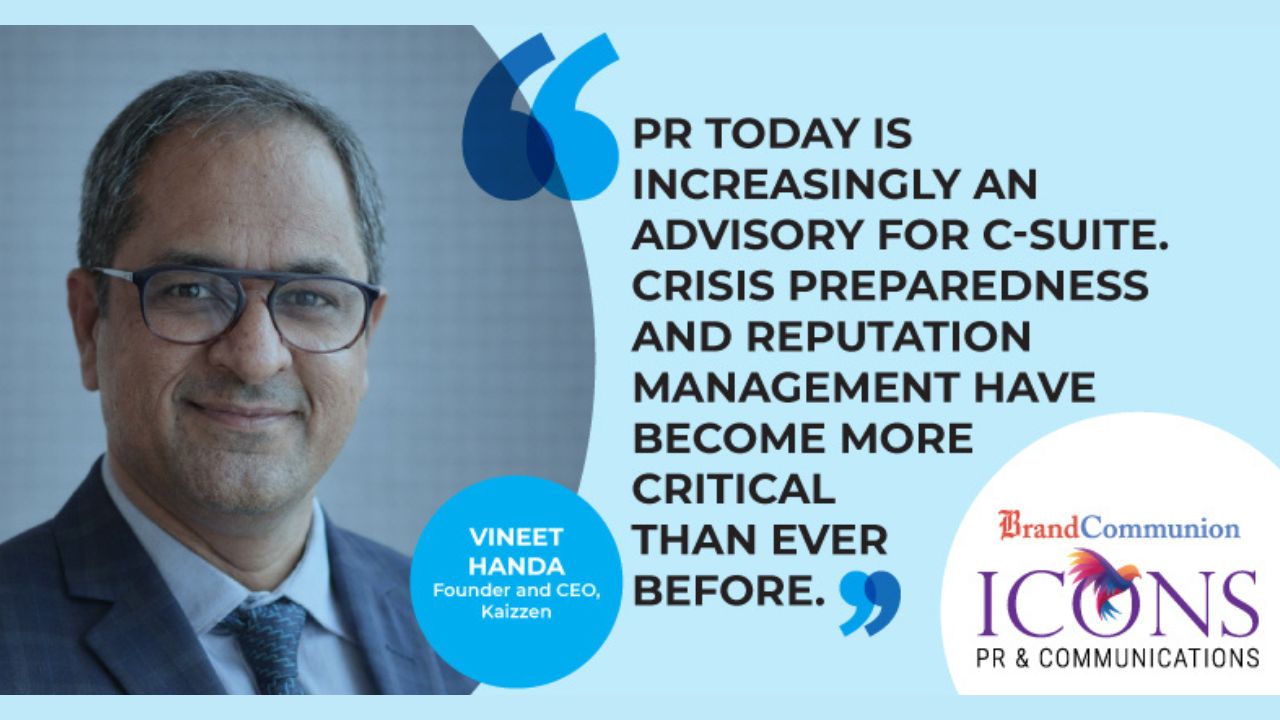


For Vineet Handa, Founder and CEO of Kaizzen, a career in public relations was never part of a grand plan. Like many professionals who entered the industry in the late 1990s, he stumbled into PR through a series of opportunities that eventually evolved into a lifelong passion.
Over the past 25 years, Handa has witnessed the communications industry transform from an era of faxed press releases and next-day news cycles to one driven by real-time digital conversations and AI-powered tools.
Yet, despite the dramatic shifts in technology and media consumption, Handa believes the fundamentals of PR have remained unchanged: trust, relationships, credibility and authentic storytelling.
In this conversation, he looks back on the defining lessons of his career, shares how the COVID-19 pandemic reshaped his perspective on leadership, and explains why the future of communications will belong to professionals who can balance artificial intelligence with human intelligence.
Edited Excerpts
Q: How did your journey in PR begin? Was it a conscious career choice or something you attribute to chance? Did your parents understand and support your decision at the time?
Like many people from my generation, I came into PR more by chance than by design. Back then, public relation was not really seen as a mainstream career option the way it is today. Most of us discovered the profession along the way rather than actively planning for it.
My first experience of PR came through an internship with ABCL when they were organizing Ms. World. It was an exciting environment and gave me an early glimpse into communications and large-scale event management. Soon after that, I got an opportunity to work in Dubai, where my professional path moved in a different direction altogether.
During the Kargil War, I decided to return to India. As I started exploring opportunities here, a family reference introduced me to Samir Kale, who was leading CMCG at the time. That introduction became a turning point.
It was quite a shift initially, but the learning and exposure were incredible. I had the privilege of working with excellent mentors who shaped my understanding of business, the value of relationships, and storytelling. Very quickly, PR stopped being just a job and became a genuine passion. And yes, my family definitely supported me.
Q: What would you consider your defining moment or breakthrough in the industry?
I honestly feel defining moments are for people who believe they have “arrived,” and I still see myself as a student of the profession. For me, every day brings a new defining moment. Every morning presents a fresh opportunity to learn, adapt, and evolve.
This industry teaches you continuously. Failures show you what you could have done differently, while successes reinforce what works. Both are equally important in shaping your journey.
I feel fortunate to have worked on meaningful assignments with some exceptional people and teams over the years. What has been truly fascinating is witnessing the evolution of the communications industry itself — from the era of fax machines, physical press releases, and 24-hour news cycles to today’s world of instant communication and 24-second reactions driven by digital and social media.
The platforms, tools, and pace may have changed dramatically, but at its core, PR still remains about trust, credibility, relationships, and authentic storytelling. That continues to inspire me every single day.
Q: Can you tell us about the toughest phase in your career, and what that period taught you?
In one word — COVID.
It did not just test me as an individual; it tested the entire industry and, in many ways, the whole world. It was a phase that taught all of us resilience, patience, empathy, and faith.
Businesses across sectors slowed or shut down. Clients were uncertain, campaigns were paused, and revenues came under pressure. But beyond the business challenges, the bigger responsibility was towards our people. One of our strongest priorities during that time was retaining our teams and ensuring they felt secure and supported despite the uncertainty around us. We understood that employees were not only dealing with professional stress but also personal anxieties — health concerns, family responsibilities, emotional strain, and financial pressures.
Along with maintaining stability within the organization, we tried our best to extend both mental and material support to our teams and communities wherever possible. In fact, it was during this phase that Kaizzen Care, our CSR initiative, was born. It emerged from a genuine need to help people during one of the most difficult periods in recent history. What started as a response to an immediate crisis eventually became a larger commitment towards community support and social responsibility.
But the most important learning is that business numbers recover with time, but how you stand by your people during difficult moments is what truly defines an institution and its culture.
Q: How have you seen PR evolve from when you started to today’s digital-first world? What are some key changes that stand out to you?
24 hours has become 24 secs. That is the evolution I have witnessed in the last 25 years of my PR career.
When I started, the industry operated at a very different pace. News moved through fax machines, press briefings, and next-day newspaper coverage. We had the time to think, respond, and shape narratives over a 24-hour cycle. Today, communication is instantaneous. A single tweet, reel, or video can go viral globally within seconds, influencing public perception in real time.
The pace of the industry has changed dramatically but so has complexity. PR today is increasingly an advisory for C-Suite. Crisis preparedness and reputation management have become more critical than ever before. Speed matters, but clarity, authenticity, and credibility matter even more. However good or creative a campaign is, consistency in what a brand voices and actually delivers matter more than ever.
Another major shift has been the integration of technology, data, and analytics into communications. Today, PR professionals are not just storytellers; they are also strategists who need to understand digital behavior, audience sentiment, AI-driven tools, and real-time engagement. The boundaries between PR, marketing, content, and digital have become increasingly fluid.
That said, at its core, PR hasn’t changed—it has always been relationships, and that remains true.
Q: What is one piece of advice you would give to someone just entering the PR industry? And if given the chance, would you still choose a career in PR today?
Without a second thought, I would still choose a career in PR. In fact, I believe this is probably one of the finest times to be in the communications industry.
Today, young professionals are surrounded by opportunities unlike ever before. The industry and the work we do encapsulate so many verticals. At the same time, they have access to incredible technology enablement that helps them research, ideate, create, execute, and measure impact in real time. The possibilities to learn and grow are immense.
My advice to people entering the industry today would be this: embrace technology, but protect the sanity and values of the profession. The current generation is truly the AI generation, and AI is an incredibly powerful tool. It can enhance efficiency, improve insights, accelerate content creation, and support better decision-making.
But my two cents would be — use AI, but don’t forget HI: Human Intelligence.
Q: Where do you see the PR industry heading in the next five years?
One trend I strongly feel will emerge is a greater demand for human-led campaigns and authentic storytelling. While AI-generated content will continue to scale rapidly, I also believe there will eventually be a certain fatigue around overly automated communication. Audiences will increasingly seek authenticity, emotion, originality, and genuine human connection.
AI will undoubtedly remain an important enabler, but the differentiator will still be human creativity, judgment, and empathy. The campaigns that truly stand out will be the ones that feel real and emotionally relevant.
Another major shift is the growing accessibility of technology and information. Platforms will continue to expand and evolve. Communication will no longer be limited to a handful of channels. From social platforms and podcasts to creator ecosystems, communities, AI-driven interfaces, and emerging digital spaces, the opportunities for engagement will become even more diverse.
One thing will remain constant: trust will continue to be the most valuable currency in communications.
Q: If your PR journey had a headline, what would it be?
Communicator with Heart.