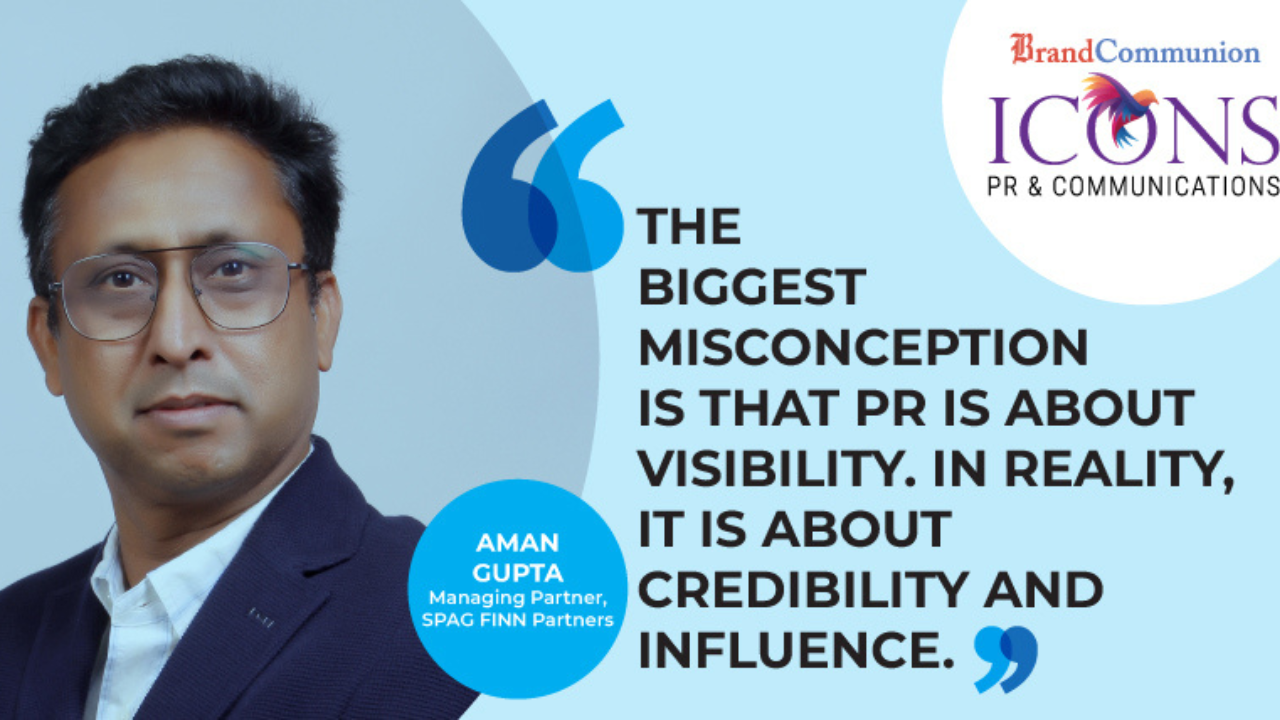


Public relations has evolved far beyond media relations and press releases to become a strategic function that shapes reputation, influences policy, and builds trust in an increasingly complex world.
Few sectors demonstrate this transformation more clearly than healthcare, where communication can have far-reaching consequences.
In this conversation, Aman Gupta, Managing Partner, SPAG, looks back at a career driven by curiosity and purpose rather than a predefined plan.
He shares how communications became a tool for creating real-world impact, the lessons learned while navigating high-stakes situations, and why the future of PR will belong to professionals who can communicate with clarity, credibility, and purpose.
Edited Excerpts
Q: How did your journey in PR begin? Was it a conscious career choice or something you attribute to chance? Did your parents understand and support your decision at the time?
My journey into PR was not a linear or fully conscious decision. It was driven more by curiosity around how ideas influence people, systems, and decisions. Early on, I realised that communication, when done right, can shape outcomes far beyond perception, especially in sectors like healthcare.
At the time, PR was not a very well-understood profession, even within families. Like many others, I had to explain what I do more than once. But over time, as the impact of the work became visible, the support followed.
Looking back, what began as curiosity became conviction. Today, I see PR not just as a career, but as a responsibility.
Q: What would you consider your defining moment or breakthrough in the industry?
There wasn’t a single moment, but a series of experiences where I saw communication move beyond awareness and actually influence policy and access.
Working on initiatives like SANKALP in partnership with diverse stakeholders, from government bodies to global health organisations, reinforced this. It showed me that when communication is grounded in evidence and aligned with public interest, it can shape decisions at scale.
That was a shift. From seeing PR as messaging to understanding it as an enabler of real-world change.
Q: Can you tell us about the toughest phase in your career, and what that period taught you?
One of the toughest phases has been working in moments where urgency is high, but clarity is still evolving, especially in healthcare and policy environments.
There are situations where decisions cannot wait, but information is incomplete. That is where judgement matters most.
What it taught me is that communication leadership is not about having all the answers. It is about knowing what to say, what not to say, and when to hold the line.
In healthcare, you learn quickly that communication is not just about visibility. It carries consequences.
Q: How have you seen PR evolve from when you started to today’s digital-first world? What are some key changes that stand out to you?
PR has moved from being a function to becoming a strategic lever.
Earlier, the focus was largely on media relations and message dissemination. Today, it sits at the intersection of policy, reputation, digital ecosystems, and stakeholder influence.
What has changed significantly is the speed and scale of information. Narratives are no longer controlled. They are shaped across platforms, communities, and algorithms in real time.
But one thing hasn’t changed. Trust still depends on clarity, credibility, and consistency. If anything, those fundamentals matter more today than ever before.
Q: What is one piece of advice you would give to someone just entering the PR industry? And if given the chance, would you still choose a career in PR today?
My advice would be to focus less on tactics and more on understanding context. PR is not about pushing messages, it is about understanding systems, stakeholders, and the impact of what you communicate.
Develop the ability to listen, interpret, and think critically. That is what will differentiate you.
And yes, I would absolutely choose PR again. Especially today. Because in a world where information is abundant but trust is scarce, the role of communication has never been more important.
Q: What is one common misconception about PR that you would like to correct?
The biggest misconception is that PR is about visibility.
In reality, PR is about credibility and influence. It is not just about being seen, but about being trusted, especially in high-stakes sectors like healthcare and public policy.
The real value of PR lies in shaping narratives that can stand up to scrutiny, not just headlines.
Q: Where do you see the PR industry heading in the next five years?
The industry is moving towards deeper integration with policy, data, and technology.
We will see PR evolve into a more advisory-driven function, where
organisations will rely on communications leaders not just for messaging, but for navigating complexity, managing risk, and shaping long-term reputation.
At the same time, AI and digital platforms will accelerate content creation, but they will also increase the need for narrative discipline.
The future will not belong to those who communicate the most, but to those who communicate with clarity, credibility, and purpose.
Q: If your PR journey had a headline, what would it be?
“Communication is not what we say. It is what changes because of it.”