

Artificial Intelligence (AI), once confined to technology forums and specialist conversations, has now moved decisively into the mainstream business agenda. It features prominently in boardroom discussions across sectors welcomed with optimism, yet approached with due caution.
Its impact, however, will not be uniform. From influencing corporate strategy to transforming how brands engage with stakeholders, AI demands sector-specific thinking and purposeful integration. Meaningful adoption extends beyond pilots and experimentation; it requires a clear strategic intent, robust governance frameworks, and alignment with long-term business priorities.
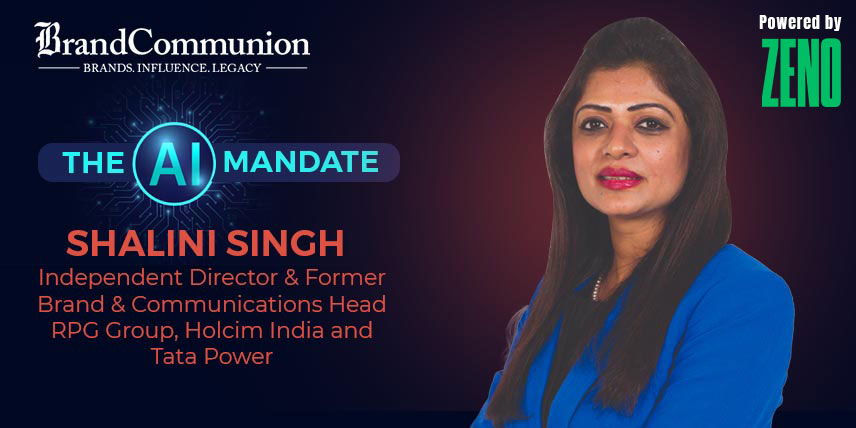
To examine these developments more closely, we are launching a new editorial series, The AI Mandate. At the heart of this series lies a central question: Is AI simply enhancing operational efficiency, or is it fundamentally reshaping organisational thinking and leadership priorities?
As part of this initiative, we spoke with Shalini Singh, Independent Director & Former Brand & Communications Head RPG Group, Holcim India and Tata Power to understand how communications functions are responding to and navigating this rapidly evolving landscape.
Q: Do you see AI merely as an efficiency accelerator, or is it fundamentally reshaping the mandate and mindset of today’s communications leader?
AI goes far beyond efficiency, it is redefining the role of the communications leader. According to a BCG report, over 80% of corporate communications tasks can be augmented or automated with AI, enabling teams to reclaim 26–36% of their time today and up to ~47% with redesigned workflows.
This isn’t just about doing the same work faster, it’s about shifting the focus from execution to strategic impact, trust creation, and reputation leadership. Communications leaders must now think like narrative architects, not just creators.
AI isn’t just speeding up communications. It’s changing what communication is. The comms leader’s mandate is moving from “crafting messages” to shaping meaning, trust, and organisational coherence at scale. As AI helps to be content abundant, the focus can now shift to judgement, credibility, and trust.
For today’s communications leader, the mindset shift is clear:
- from creator to curator
- from publisher to trust architect
- from reactive reputation management to proactive narrative advantage
- from “communications as a function” to communications as enterprise infrastructure
AI is replacing low-value communication and raising the premium on strategic communications.
Q: How are you deploying AI across internal and external communications, and have you established a structured toolkit or framework to guide its use?
As a former Group Head Brand and Communications-RPG Group, we deployed AI across four structured layers that reflect both tactical efficiency and strategic rigour:
1) Sense & monitor: AI-powered listening for sentiment and issue signals
2) Strategy & narrative testing: AI models help simulate response scenarios and measure message resonance
3) Creation & optimisation: Rapid drafting, variants, localisation, and GEO-aware outputs
4) Governance & ethics: Guardrails, approvals, and brand voice control
This framework stems from real organisational experience, including using AI for moment marketing and video production.
Q: With the shift from SEO to Generative Engine Optimisation (GEO), how is your communication strategy evolving to stay visible in an AI-driven discovery ecosystem?
We’re evolving from SEO-centric tactics to a GEO mindset because discovery isn’t just about ranking anymore, it’s about being cited, referenced, and trusted in AI-generated answers.
Generative Engine Optimization means structuring content so AI platforms like ChatGPT, Gemini, and Perplexity can understand, extract, and surface it as authoritative. This requires clear metadata, fact-based signals, and narrative depth not just keywords and backlinks. If you’re not appearing in AI answers, you’re essentially invisible in the new front door of discovery. You also need to focus strongly on your owned and earned media strategy to achieve differentiation.
Q: Which function within corporate communications is most susceptible to AI disruption content creation, crisis response, media relations, or reputation intelligence and why?
Content creation will see the most visible disruption, as AI rapidly generates drafts, variants, and formats. But the most strategically important transformations will occur in:
- Reputation intelligence, where AI synthesises multi-channel signals in real time
- Crisis response support – where AI accelerates detection and scenario modelling, but human judgement still anchors decisions
- Media relations optimisation – where AI helps tailor pitches and identify trends
The best-performing teams will be those that elevate analysis and strategic readiness, not just content production.
Q: What new skills do communication teams need to remain relevant?
As AI adoption expands with surveys showing the vast majority of organisations using AI in at least one business function the differentiator is how people work with AI, not whether they use it.
High-value skills now include:
- AI strategy & prompt design – guiding AI to produce aligned outputs
- Narrative architecture & editorial judgement – deciding what matters most
- GEO and AI discovery literacy – optimising for AI visibility, not just search
- Reputation intelligence and risk management – interpreting signal at scale
- Ethics & governance – ensuring responsible, transparent AI use
Teams that build these capacities will drive enterprise value, not just output.
Q: Looking ahead five years, how will AI transform comms structures and influence?
In five years, communications is likely to resemble the “AI-orchestrated” functions emerging in forward-looking organisations not merely as users of tools, but strategic integrators of AI-driven insights and narrative pathways.
We can expect the following:
- Lean execution functions and expanded strategic roles
- AI-controlled workflows with human oversight at the centre
- Deeper ties to enterprise strategy, risk, governance, and boardroom decision-making
- Roles oriented around reputation intelligence, narrative design, and AI governance
This shift mirrors broader adoption patterns seen across industries: while nearly 90% of organisations report AI usage, only a fraction scale it into strategic impact indicating a major value opportunity for communications teams that do.