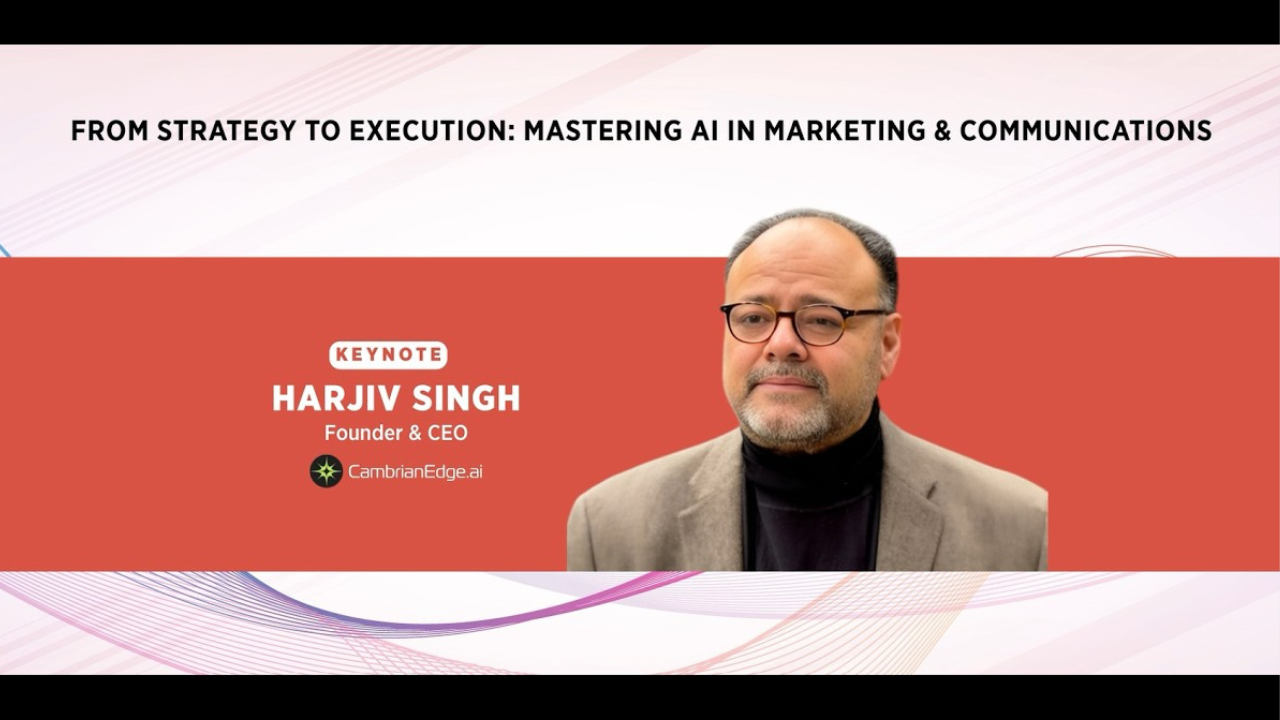


Artificial Intelligence is not a threat to marketing jobs; it is an opportunity for marketers willing to evolve, according to Harjiv Singh, founder of CambrianEdge.ai, who presented a keynote address to industry leaders at the flagship event of BrandCommunion Convergence Summit.
Speaking to the audience of marketing and communications professionals, Singh argued that the biggest misconception surrounding AI is that it will eliminate jobs. Instead, he said, the real risk lies with professionals who fail to embrace the technology.
"The only jobs that disappear are those of people who do not learn to use AI," Singh said, adding that AI should be viewed as the next foundational layer of organisational intelligence rather than just another productivity tool.
Singh described marketing as one of the most complex business functions today, spanning public relations, digital marketing, social media, research and analytics. This fragmentation, he said, has made it increasingly difficult for chief marketing officers to demonstrate business impact. AI, when implemented strategically, can help unify these functions by creating a single source of intelligence across organisations.
He also noted that CMOs continue to have the shortest average tenure among C-suite executives, largely because of mounting pressure to deliver measurable business outcomes. Rather than focusing on optics, marketing leaders must increasingly demonstrate revenue impact, with AI serving as an enabler of better decision-making rather than merely accelerating existing processes.
According to Singh, AI adoption is progressing through three distinct stages. The first involves individuals using AI to improve personal productivity. The second focuses on organisations collaborating around shared AI-powered intelligence, while the third envisions AI agents handling routine tasks, allowing humans to concentrate on judgment, creativity and strategic decision-making.
He stressed that many organisations have failed to realise meaningful returns from AI investments because they have treated the technology as a software upgrade rather than an organisational transformation.
"The biggest challenge with AI adoption isn't the technology,it's the people," Singh said, adding that businesses must move employees from AI literacy to AI fluency if they want to unlock enterprise-wide value.
Singh likened AI's arrival to the introduction of electricity, arguing that companies need to rewire their organisational structures to fully benefit from the technology. Traditional marketing teams, often split across content, PR, digital and creative functions, need to collaborate around a common intelligence layer rather than continue operating in silos.
Highlighting the competitive advantage available to smaller companies, Singh said AI has significantly narrowed the intelligence gap between large enterprises and agile organisations. Smaller businesses, he argued, can now move faster and compete more effectively if they integrate AI into their workflows early.
Singh also pointed to India's demographic advantage, calling the country's young workforce one of its greatest strengths in the global AI race. With global technology giants investing billions of dollars in AI infrastructure and data centres, he said Indian professionals are well-positioned to lead AI adoption worldwide.
He concluded by encouraging marketers to embrace experimentation, build AI fluency and champion organisational change rather than fear disruption.
"Don't fear this technology," Singh said. "You have a phenomenal advantage if you can harness it and use it to elevate your career opportunities."
You can watch the full video here: