

Artificial Intelligence (AI) restricted to technology forums and specialist discussions, has firmly entered the mainstream business agenda.
Today, it is a constant presence in boardroom conversations across industries approached with both enthusiasm and careful consideration.
Its influence, however, will not be uniform. From shaping corporate strategy to redefining how brands connect with their audiences, AI calls for sector-specific adaptation and deliberate integration.
Successful adoption goes beyond experimentation; it requires clarity of intent, strong governance frameworks, and close alignment with long-term business goals.
To explore these shifts in depth, we are launching a new editorial series titled The AI Mandate. At its core, the series asks a pivotal question: Is AI merely improving efficiency, or is it fundamentally reshaping organisational mindsets and leadership priorities?
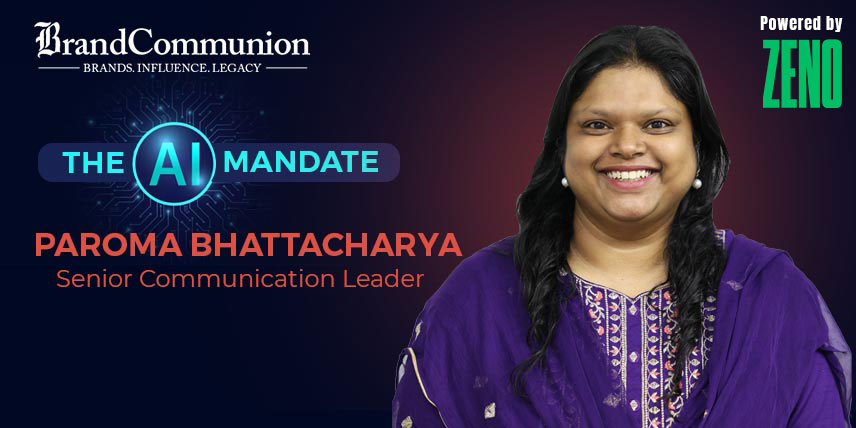
As part of this conversation, we spoke with Paroma Bhattacharya, Senior Communication Leader, to understand how communications functions are adapting to and navigating this evolving landscape.
Edited Excerpts:
Q: Do you see AI merely as an efficiency accelerator, or is it fundamentally reshaping the mandate and mindset of today’s communications leader?
AI is not just an efficiency accelerator; it is fundamentally reshaping the mandate of today’s communications leader. Over my 16 years across the sector, I’ve seen communications evolve from message dissemination to strategic reputation management.
AI accelerates that shift by moving us from reactive storytelling to predictive influence. Today, we are expected to interpret data signals, anticipate stakeholder sentiment, and manage trust in real time. The mindset has shifted from being content custodians to reputation architects. We are now responsible not only for narratives but also for governance, ethical AI adoption, misinformation preparedness.
Q: How are you deploying AI across internal and external communications, and have you established a structured toolkit or framework to guide its use?
In the context of Media PR and video communications, our approach to AI is focused on production efficiency and content amplification not on drafting press materials. All press releases, official statements, and media responses remain human-written to ensure strategic nuance, contextual sensitivity, and credibility.
Where AI has added significant value is in video-led storytelling, which is increasingly central to Media PR. We use AI-enabled video editing tools for automated captioning, multilingual subtitles, voice clean-up, and rapid formatting of long-form interviews into short, platform-specific clips. This is particularly effective when repurposing leadership interviews, event coverage, or field stories into media-ready digital assets.
AI tools also help with background noise reduction, visual enhancements, and generating highlight cuts that make content more newsroom- and social-friendly.
In Media PR operations, AI-powered media monitoring and analytics platforms support us with real-time sentiment tracking, coverage analysis, journalist mapping, and identifying narrative trends across publications and broadcasts. These tools help us understand which angles are gaining traction, how spokespeople are being quoted, and where reputational risks may be emerging. Additionally, AI-assisted transcription tools
Q: With the shift from SEO to Generative Engine Optimisation (GEO), how is your communication strategy evolving to stay visible in an AI-driven discovery ecosystem?
The shift from SEO to Generative Engine Optimisation is redefining discoverability. Earlier, ranking on search engines was the priority; today, being cited, summarised, and referenced by generative AI systems is equally critical.
This means our strategy now prioritises authoritative, well-structured, and insight-rich content that AI models can easily interpret and surface. We focus on publishing credible long-form thought leadership, embedding clear data points, and maintaining narrative consistency across platforms so that our positioning is reinforced in AI-generated responses.
Earned media in trusted publications has become even more valuable because generative engines rely heavily on credible sources. Particularly in the NGO sector, where policy influence matters, being part of the AI-informed knowledge layer is now central to advocacy impact.
Q: Which function within corporate communications is most susceptible to AI disruption and why?
Content creation is the most immediately susceptible to AI disruption. AI tools can already generate competent first drafts of press releases, social posts, speeches, and reports in seconds, which commoditises baseline production. However, disruption does not mean replacement.
The higher-value elements strategic framing, stakeholder sensitivity, cultural nuance, and ethical judgement remain deeply human. Reputation intelligence will become increasingly AI-powered, but that represents augmentation rather than displacement.
Crisis response, in particular, still demands human judgement under pressure. Media relations, built on trust and long-term credibility, will continue to be relationship-led, even if AI enhances preparation and responsiveness. In essence, AI will handle the mechanics of communication, while humans remain responsible for meaning and judgement.
Q: What new skills do communication teams need to remain relevant in an AI-first environment?
Communication teams must develop AI fluency alongside strategic and human-centric capabilities. This includes understanding how AI models work, recognising bias and limitations, interpreting data insights, and applying ethical governance. Beyond technical literacy, teams need stronger analytical thinking to detect narrative shifts, forecast reputational risks, and synthesise complex information into strategic counsel.
Equally important are timeless human skills, empathy, ethical reasoning, cultural intelligence, and trust-building. Particularly in NGOs and mission-driven organisations, credibility and authenticity cannot be automated. The communicator of the future must operate at the intersection of technology, strategy, and ethics.
Q: Looking ahead five years, how do you envision AI transforming corporate communications within organisations?
Over the next five years, I see AI elevating the role of corporate communications rather than diminishing it. Teams may become leaner but more specialised, with roles focused on AI governance, reputation analytics, and narrative strategy. Communications will integrate more closely with risk, legal, and data functions, and leadership teams will rely on real-time reputation dashboards to inform decision-making.
The skill profile will shift from execution-heavy roles to strategic advisory capabilities. Importantly, communications leaders will have greater influence at the executive table, advising on AI-related reputational risks, misinformation management, ESG positioning, and trust-building in an algorithm-driven world. For someone who has worked across NGOs and corporates, it is clear to me that AI will not replace the communicator, it will demand that we evolve into sharper strategists, stronger ethical stewards, and more data-informed leaders.