

In an industry driven by perception, storytelling, and trust, a few individuals stand out for shaping narratives that truly matter. We recently unveiled Brand Communion’s Icons 2026 leaders whose journeys have not only defined their own careers but have also contributed to the evolution of the industry itself.
Check out the list, if you haven’t: https://www.brandcommunion.com/pr-and-communication/brandcommunion-icons-2026-celebrating-the-pillars-of-indias-pr-industry
With this ongoing series, we aim to go beyond the accolades and uncover the stories behind their success tracing early beginnings, pivotal moments, and the challenges that shaped their paths. From navigating industry shifts to adapting in a rapidly transforming landscape, these conversations offer a candid and inspiring look at what it takes to build a lasting legacy in PR.
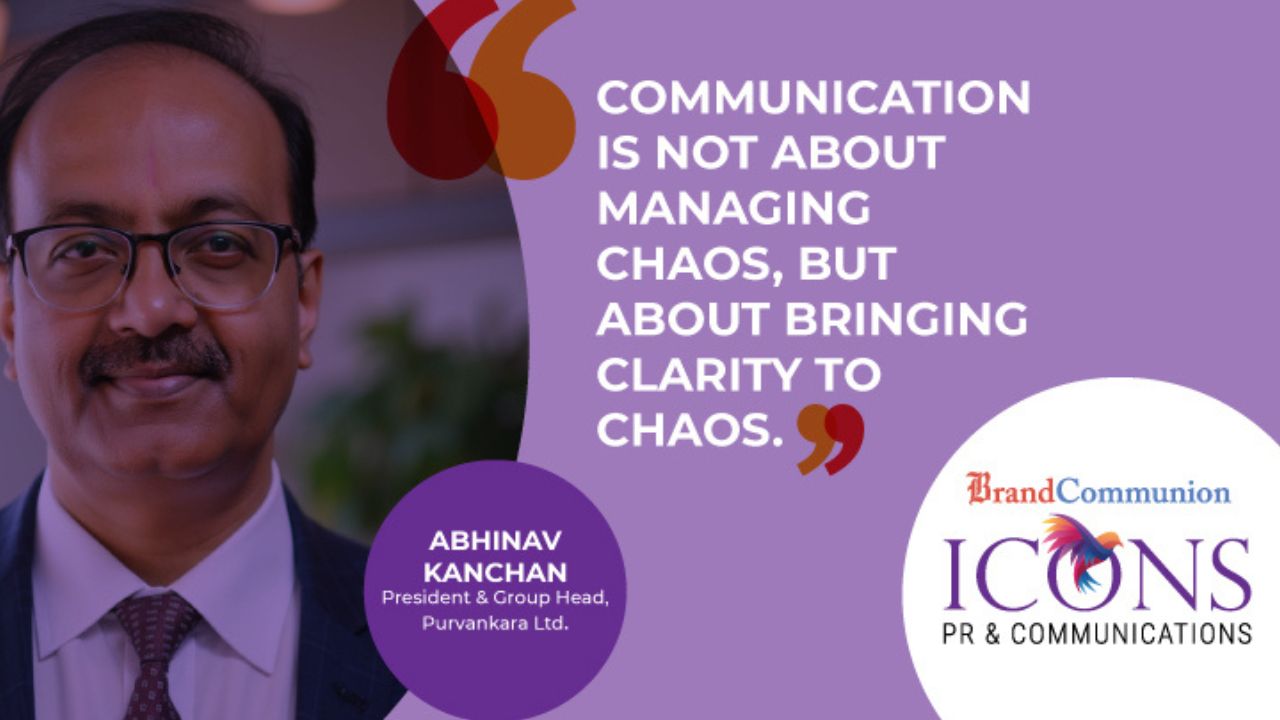
We begin the series with Abhinav Kanchan, President & Group Head, Puravankara Ltd. In this conversation, we explore his journey into PR at a time when the industry was still taking shape, the defining moments that influenced his career, and the breakthroughs that set him apart.
We hope you enjoy the read.
Edited Excerpts
Q: How did your journey in PR begin? Was it a conscious career choice or chance? Did your parents support it?
I graduated in 1990 and completed my Master’s in 1992 from St. Stephen’s, University of Delhi. Around that time, India was going through a severe economic crisis—foreign exchange reserves had plummeted, inflation was high, and jobs were scarce.
The 1991 economic reforms marked a turning point, dismantling the license raj and opening up the economy. However, the transition was harsh. Between 1991 and 1994, public sector hiring was nearly frozen, and private employment shrank as inefficient units shut down. While liberalisation promised new opportunities for fresh graduates, the white-collar job market remained limited and uncertain.
For students from social sciences and humanities backgrounds, opportunities were limited. Careers in media, journalism, mass communication, or PR were often overlooked due to low pay, with most graduates prioritising fields like IT, finance, engineering, civil services, and banking.
However, change was quietly underway. The early ’90s saw the rise of satellite television, and by the late ’90s, the dot-com boom began creating better-paying opportunities. As television and digital media evolved into more viable and exciting career paths, the communications and PR industry also began to gain momentum.
In my pursuit of a career in media, I went through multiple applications, meetings, and interviews—facing several rejections along the way. Eventually, I received three entry-level offers almost simultaneously from FICCI, NDTV, and Business Today. Since FICCI’s offer came first, I chose to begin my career there.
Although not a media house, FICCI, being an apex chamber of commerce and industry, placed me in its Press & Publications Division. It didn’t take long for me to develop a deep interest in PR, drawn to its dynamic nature, constant learning, and the guidance of capable seniors.
The experience offered strong camaraderie, valuable networking opportunities, and a sense of contributing to a larger purpose of business and nation-building. Looking back, it feels like I was meant to begin my journey at FICCI. Throughout, my parents remained supportive, as long as I was happy and engaged in my work.
Q: What would you consider your defining moment or breakthrough?
I’ve been fortunate to experience several defining moments over my three-decade career. Each organisation I’ve worked with—FICCI, Aditya Birla Group, ArcelorMittal, Moser Baer, Sobha, and now Puravankara brought its own challenges and learning opportunities.
That’s the beauty of working across industries: every situation demands a different approach.
One standout memory is working on the first Pravasi Bharatiya Divas in January 2003 in New Delhi, organised by FICCI to strengthen engagement with the Indian diaspora. The event was inaugurated by the Prime Minister, attended by the Union Cabinet, senior policymakers, and a global diaspora audience.
Key discussions included initiatives like the PIO card scheme and dual citizenship for select regions.
I was part of the team managing over 1,500 journalists from across the world. We set up one of the most advanced media centres of that time, ensuring seamless information flow and access. The scale and quality of media coverage we achieved remains unmatched in my experience, making it a truly landmark event for me.
Beyond my early experiences at FICCI, I’ve had several adrenaline-filled moments across organisations. At the Aditya Birla Group, conducting communication workshops at VSF units was deeply engaging. At ArcelorMittal, I worked on an FM radio program in the tribal language Sadri to support land acquisition for a new steel plant and address local concerns.
At Moser Baer, a key milestone was the inauguration of what was then Asia’s largest solar plant in Gunthawada, bringing uninterrupted power to 18,000 villages. During my time at Sobha, we executed over 60 “Connect” programs meeting more than 5,000 customers, capturing feedback on camera, and using those insights to improve internal processes.
It’s difficult to compress three decades of experiences into a few lines.
Even today, I see each day as an opportunity to explore new ideas. What defines these moments for me is the ability to navigate complexity with clarity, honesty, and empathy values that continue to shape my journey in communications.
Q: Can you tell us about the toughest phase in your career, and what it taught you?
During my time at ArcelorMittal India, we faced a serious perception challenge in the tribal districts of Khunti and Gumla in Jharkhand, where we planned to set up a steel plant.
The local communities feared that the company would take away their land and with it, their identity. The region was also under the influence of Naxalism, making the situation even more volatile. At one point, our CEO was gheraoed by nearly 3,000 tribals armed with traditional weapons, and we were advised against any direct interaction with villagers due to safety risks.
The company needed to acquire 10,000 acres of land for a 20 million tonne plant, but conventional communication approaches were ineffective. This required a completely different, ground-up strategy.
Amidst these challenges, we launched “Saath Chalenge Sab”, a FM radio program in the local tribal language, Sadri, enriched with folk music. We distributed radio sets in villages and engaged local youth as correspondents to gather real concerns and relay them back to us. Using these insights, we crafted content that addressed fears with honesty, clarity, and cultural sensitivity.
The impact was swift. Within weeks, villagers began approaching our Ranchi office with their land documents, willing to engage in dialogue.
This experience reinforced a powerful lesson: what cannot be achieved through power or persuasion can often be achieved through honest, empathetic communication. In moments of uncertainty, communication is not about managing perception, it’s about building trust and bringing clarity to chaos.
Above all, it underscored that truth must remain the foundation of any communication. Narratives built without it may exist briefly, but they won’t endure. As the saying goes, “Baat karne se baat banti hai”, but more importantly, it’s about how you communicate, with what intent and authenticity. This experience left a lasting impact on me.
Q: How have you seen PR evolve from when you started to today’s digital-first world?
The landscape has transformed majorly over the decades, from linear communication to a dynamic, digital-first ecosystem where conversations are often constant, overwhelming and multi-directional.
Earlier, the communication focused on managing channels. Today, it is more about engaging diverse stakeholders in real time, often in environments where narratives are continuously evolving. Due to the constant outpour of information from a plethora of digital outlets, we are always faced with a cacophony of noise on any topic. Fake news and views have muddied the place further. It has become more difficult to stand out in this clutter.
What hasn’t changed, however, is the need for trust. In fact, it has only become more critical. Technology can amplify voices, but only authenticity, backed by logic and empathy, can sustain credibility and create immense trust in the narratives you choose to take forward.
Q: What advice would you give someone entering PR today? Would you still choose this career?
Stay curious, stay grounded, and always lead with purpose.
Communication is more than words, it’s about aligning what you say, do, and stand for. The Trust Triangle authenticity, logic, and empathy is the foundation of meaningful communication.
This profession will challenge you, but its real rewards lie in the intangible value you create: trust, credibility, and connection.
Given the choice, I would choose this journey again because over time, it becomes more than a profession; it becomes something you truly care about, with endless scope to create meaningful change.
Q: What is one common misconception about PR you’d like to correct?
PR should not be seen as spin or a gloss over a flawed reality—nor is it about silencing negative press, especially when it speaks the truth.
Communication isn’t about managing perception alone. At its core, every organisation is a story shaped by its direction, values, and moral compass. Even the best work cannot create impact or legacy if it isn’t communicated effectively to employees and stakeholders.
Ultimately, communication is about building trust. Without truth at its foundation, it may create noise but never lasting value.
Q: Where do you see the PR industry heading in the next five years?
As we look ahead, the communications landscape will evolve rapidly, with AI reshaping how the function operates. Routine tasks will increasingly be automated, allowing communicators to focus on insights, strategic judgement, and bringing clarity to complexity.
At the same time, risks will grow misinformation, deepfakes, and the speed of narratives will demand faster, sharper, and more responsible responses. In such a world, communication cannot remain reactive; it must be anchored in truth.
This is where corporate communications and PR will play a stronger role as strategic advisors, helping organisations move forward with trust and alignment.
In an AI-driven world, while technology may shape narratives, it is trust, authenticity, and cultural understanding that will remain the most valuable currency.
Q: If your PR journey had a headline, what would it be?
“In the end, we will all become stories”