

Artificial Intelligence (AI), once a term largely confined to technology forums, has now entered mainstream vocabulary. It increasingly shapes everyday conversations sparking equal parts optimism and caution. What once felt futuristic is now actively influencing how we work, communicate, and make decisions.
AI remains synonymous with surface-level applications with editing text through ChatGPT or generating images on command. Its true potential, however, extends far deeper.
From reshaping organisational decision-making to redefining stakeholder engagement, AI is set to impact industries in distinct ways, demanding tailored strategies for implementation.
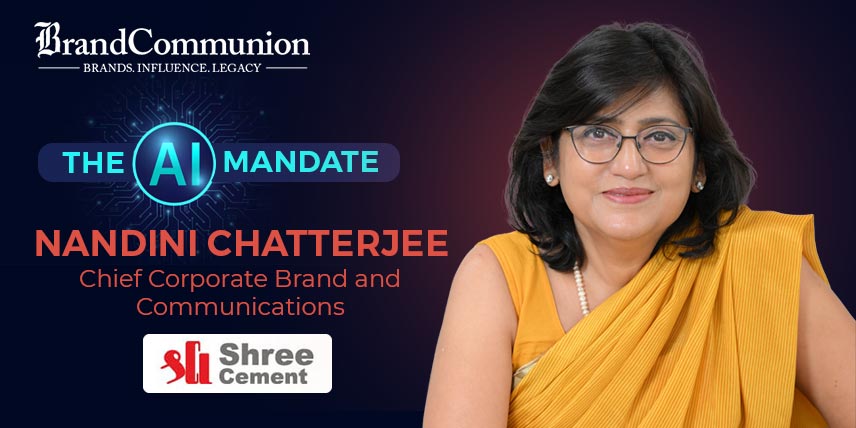
To explore this rapidly evolving landscape, we are launching a new series titled The AI Mandate. The series examines whether AI is simply accelerating efficiency or fundamentally transforming organisational thinking. Are businesses ready to embed AI into their core operations? Have they built clear governance frameworks? And how is the traditional Google-led SEO journey gradually giving way to ChatGPT-driven Generative Engine Optimisation (GEO)?
The first episode turns the spotlight on communication leaders, the stewards of brand reputation and explores how AI is driving a shift from conventional playbooks to more adaptive, intelligence-led approaches.
As part of this series, we spoke with Nandini Chatterjee, Chief Corporate Brand and Communications, Shree Cement.
Edited Excerpts:
Q: Do you see AI merely as an efficiency accelerator, or is it fundamentally reshaping the mandate and mindset of today’s communications leader?
AI has undoubtedly accelerated efficiency. That much is evident. Tasks that once required larger teams such as research, drafting initial versions, summarising reports, or structuring ideas can now be completed far more quickly using basic AI tools. Most of us are already engaging with AI at this functional level.
However, I believe AI is gradually reshaping the mandate of a communications leader. Organisations and individuals are at varying stages of AI maturity, some are deeply experimenting with its capabilities, while others are still cautiously exploring its potential.
What is clear, though, is that AI is compelling us to reassess where we invest our time and energy. In my view, the true value-driven end of productivity will only continue to strengthen in the years ahead.
Q: How are you deploying AI across internal and external communications, and have you established a structured toolkit or framework to guide its use?
AI is currently being deployed across both internal and external communications, primarily to enhance efficiency in research, content development and analysis. At the same time, our partner agencies are leveraging more advanced AI driven analytics and sharing deeper insights with us, which is adding meaningful value to our decision making.
We are also using AI quite actively for our video and social media content. For instance, we recently created an AI enabled safety mascot, ‘Shreemaan Hamesha Savdhan’, at Shree Cement, and are using him across multiple scenarios to drive safety awareness, internally and externally. AI has made it much easier to visualise and deploy such creative assets at scale.
We do have internal guidelines in place to guide responsible use of AI. However, like most organisations, we recognise that this is still an evolving space and there is considerable headroom to build more structured and mature frameworks going forward.
Q: With the shift from SEO to Generative Engine Optimisation (GEO), how is your communication strategy evolving to stay visible in an AI-driven discovery ecosystem?
The shift from SEO to Generative Engine Optimisation is clearly influencing how we think about visibility. For communications leaders today, credibility and evidence based content are becoming critical, as AI led discovery increasingly draws from owned platforms, credible media coverage and well indexed thought leadership.
The focus is therefore moving from pushing what a company wants to say to creating content that audiences are actively searching for. Intent is the new currency. If content is not useful, relevant and authoritative, it simply will not surface in an AI driven environment.
In that sense, GEO is pushing communications leaders to become far more audience focused and insight led.
Q: Which function within corporate communications is most susceptible to AI disruption content creation, crisis response, media relations, or reputation intelligence and why?
AI-driven disruption is most evident in routine, process-oriented tasks. Content creation sits at the heart of this shift, as activities such as basic drafting, summarising, and language refinement are relatively straightforward for AI to execute.
That said, the more strategic dimensions of communications continue to be human-led. Even in areas like crisis management or media relations, AI can assist with inputs and draft responses, but it cannot reliably determine the most appropriate narrative in a sensitive moment, interpret stakeholder sentiment, or draw upon institutional memory and long-standing relationships.
In my view, the defining boundary is judgment. Situations that require context, empathy, and real-time decision-making still depend on human intelligence. Ultimately, the accountability for narrative direction, relationship management, and reputation stewardship will remain with communications leaders.
Q: What new skills do communication teams need to remain relevant in an AI-first environment?
In today’s AI driven environment, the core human skills of communication will continue to matter. Building relationships, empathy, strategic thinking and strong sense making will remain key differentiators that AI cannot easily replace.
What teams now need to strengthen are analytical capabilities. A senior leader at the AI summit recently underscored the growing importance of statistics and data literacy, and that insight strongly resonates.
Communication professionals are increasingly becoming more comfortable working with data, interpreting analytics and drawing actionable insights.
Q: Looking ahead five years, how do you envision AI transforming the structure, skillsets, and influence of corporate communications within organisations?
As AI steadily takes over routine and repetitive tasks within corporate communications, teams are likely to become leaner. The real shift, however, will be in the value that communications teams bring to leadership.
As communicators move into sharper interpretation of complex situations, stronger narrative building and sound judgment, the influence of the function is likely to rise meaningfully within organisations. Leadership teams will increasingly look to communications for perspective, early signals and reputation stewardship.