

Artificial Intelligence (AI), once a buzzword confined to tech circles has now become a part of our everyday vocabulary. It quietly finds its way into daily conversations, prompting both excitement and apprehension in equal measure. What was once considered futuristic is now actively influencing how we work, think, and communicate.
Reinforcing this growing significance, India recently hosted the India AI Impact Summit 2026, a flagship global gathering organised by the Government of India under the IndiaAI Mission highlighting the nation’s intent to transition from AI awareness to meaningful AI adoption.
However, for many, the understanding of AI remains limited to functional use cases, be it refining a paragraph through ChatGPT or generating images on demand. In reality, its potential extends far beyond these applications.
From transforming organisational decision-making to redefining audience engagement, AI is poised to impact every sector differently, requiring tailored approaches to integration and implementation.
To unpack this evolving landscape, we are introducing a new series titled ‘The AI Mandate’. The series aims to explore whether AI is merely acting as an efficiency accelerator or fundamentally reshaping organisational mindsets. Are businesses truly prepared to integrate AI into their operations? Have they developed structured frameworks for its adoption? And how is the traditional search journey from Google-led SEO gradually shifting towards ChatGPT-driven GEO (Generative Engine Optimisation)?
The first episode of the series focuses on communication leaders, the custodians of brand reputation and examines how AI is prompting a shift from traditional practices towards more adaptive, intelligence-led strategies.
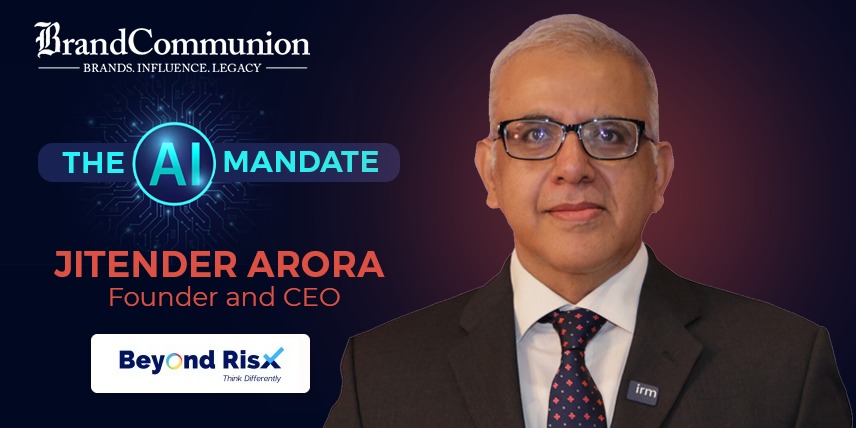
As part of this conversation, we spoke with Jitender Arora, Founder and CEO of Beyond RisX, a Bengaluru-based boutique risk consulting and advisory firm that enables organisations to navigate a wide spectrum of business and technology risks.
Q: Do you see AI merely as an efficiency accelerator, or is it fundamentally reshaping the mandate and mindset of today’s communications leader?
Jitender: AI is more than an efficiency tool. While it improves speed, productivity, and automation, it is also redefining leadership roles.
Communication is no longer just about messaging, it now involves shaping narratives, building trust, and managing reputation risk in a hyper-digital ecosystem. AI increases scale and speed, but also heightens misinformation, reputational volatility, and stakeholder scrutiny.
Today’s communications leaders must think like risk strategists serving not just as storytellers, but as custodians of institutional credibility in an AI-driven world.
Q: How are you deploying AI across internal and external communications, and have you established a structured toolkit or framework to guide its use?
Jitender: Oftently, we see organizations deploying AI tools without embedding governance. At Beyond RisX, we use AI with many facets of our work including communications, but critically, we operate within a structured AI governance framework anchored on:
- Human-in-the-loop validation
- Data privacy and compliance alignment (especially under India’s DPDP regime)
- Bias and hallucination risk controls
- Traceability of AI-assisted outputs
In our advisory work, spanning risk assessments, third-party risk reviews, ESG oversight, and AI risk evaluations, we emphasize “governance by design.” AI should be integrated into enterprise risk management frameworks, not treated as an isolated innovation initiative.
Q: With the shift from SEO to Generative Engine Optimisation (GEO), how is your communication strategy evolving to stay visible in an AI-driven discovery ecosystem?
In a GEO environment, AI models surface content that demonstrates depth, credibility, and structured expertise. Superficial content will be ignored.
Our strategy focuses on:
- Long-form thought leadership rooted in domain authority (risk, governance, resilience, ESG, AI risk).
- Structured content architecture that is machine-readable and semantically coherent.
- Publishing insight-led narratives that position us as knowledge originators, not aggregators.
- Ensuring our digital footprint signals expertise through research, frameworks, and practitioner experience.
In the AI era, visibility will not be bought; it will be earned through intellectual substance
Q: Which function within corporate communications is most susceptible to AI disruption content creation, crisis response, media relations, or reputation intelligence and why?
Jitender: Content creation is already disrupted. AI can already draft press notes, speeches, and social content in seconds. The commoditization of generic content is inevitable.
However, the most strategically impacted function will be reputation intelligence. AI can now detect narrative shifts, sentiment inflections, misinformation propagation, and reputational risks in real time.
Crisis response will become AI-augmented but must remain human-led. Media relations will evolve toward relationship stewardship rather than information distribution.
Q: What new skills do communication teams need to remain relevant in an AI-first environment?
Jitender: In my mind, three skill clusters will define relevance:
- AI Literacy and Prompt Engineering: Teams must understand model behaviour, limitations, bias patterns, and validation techniques.
- Data Interpretation and Risk Awareness: The ability to interpret AI-generated insights critically and assess reputational, regulatory, and ethical implications.
- Strategic Judgment and Narrative Design
AI can generate language; it cannot generate conviction. Human teams must retain the ability to craft purpose-driven, value-aligned narratives. Additionally, ethical decision-making will become central. Communications will increasingly intersect with compliance, cybersecurity, and governance.
Q: Looking ahead five years, how do you envision AI transforming the structure, skillsets, and influence of corporate communications within organisations?
Jitender: In five years, corporate communications will look fundamentally different.
- Teams will be leaner but more analytically sophisticated.
- AI copilots will handle monitoring, first-draft generation, and sentiment scanning.
- Communications leaders will sit closer to the CEO and the Board, because reputation risk will be quantified in real time.
- The function will integrate deeply with enterprise risk management and digital strategy.