

Artificial Intelligence is no longer just another technological wave for communicators to manage. Today, it sits at the centre of boardroom conversations across industries embraced with optimism, yet approached with considered caution.
More importantly, it represents a structural shift in how reputation is built, interpreted, and amplified.
Its impact will not be uniform. From influencing corporate strategy to redefining how brands engage with stakeholders, AI demands sector-specific insight and deliberate, well-governed integration.
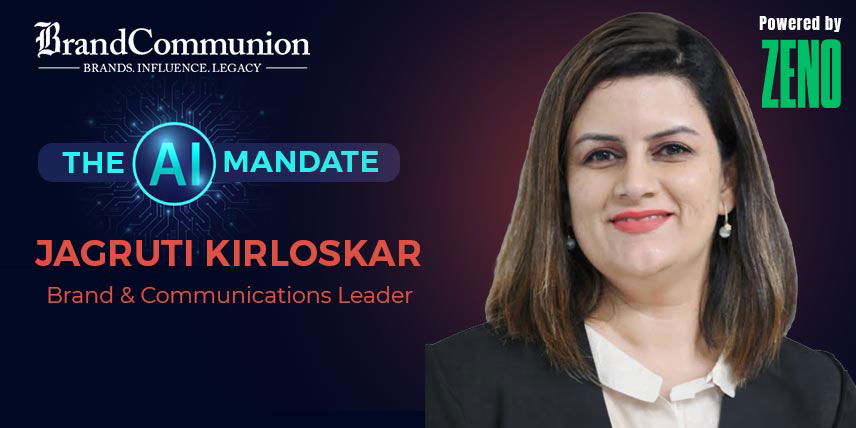
To examine these shifts more closely, we are launching a new editorial series, The AI Mandate. At its heart lies a defining question: Is AI simply accelerating operational efficiency, or is it fundamentally reshaping organisational thinking and leadership priorities?
As part of this series, we spoke with Jagruti Kirloskar, Brand & Communications Leader, to understand how communications leaders are adapting to and navigating this rapidly evolving landscape.
Edited Excerpts:
Q: Do you see AI merely as an efficiency accelerator, or is it fundamentally reshaping the mandate and mindset of today’s communications leader?
AI isn’t just automating tasks, it’s redefining how reputation is formed and who owns it. In the past, communicators focused on message control: what we said, to whom, and when. In an AI-first world, that paradigm has shifted toward narrative compression. Increasingly investors, partners, regulators rely on AI systems to synthesise a brand’s reputation before the brand even speaks.
What gets retained and repeated is not always what we want. It’s what travelled widest, fastest, and often without nuance.This challenges the very mandate of communications leadership. We are moving from message management to memory management shaping the inputs that AI systems use to define our brand footprint.
This is not just about efficiency. It requires a mindset rooted in the strategic architecture of digital signals and long-term reputation design. That is why roles such as Chief Reputation Officer are emerging as C-suite imperatives.
Encouragingly, some global organisations are already embracing titles like Chief Brand & Reputation Officer in their leadership mandates.
Q: How are you deploying AI across internal and external communications, and have you established a structured toolkit or framework to guide its use?
AI requires governance, not just access. Internally, AI can function as a language and insight engine automating routine drafting (saving time) while freeing human capacity for higher-order thinking: framing problems, assessing cultural context, and anticipating stakeholder perception. Externally, AI can monitor real-time reputation signals, sentiment shifts, and narrative patterns across platforms, not just generate content.
A structured framework should focus on:
Narrative Anchors: Authoritative content: leadership POVs, data explainers, FAQs that AI systems are more likely to prioritise and elevate.
Ethics Guardrails: Calibrating AI outputs against brand values, legal considerations, and cultural nuance. This ensures AI functions as a strategic partner, not a blind generator.
Q: With the shift from SEO to Generative Engine Optimisation (GEO), how is your communication strategy evolving to stay visible in an AI-driven discovery ecosystem?
The era of SEO is giving way to GEO, where AI engines decide what gets cited and what gets ignored. Visibility is no longer about keywords on a page. It is about high-authority, context-rich digital anchors that generative systems trust and repeat. We have moved from ranking pages (SEO) to shaping machine understanding (GEO). The next realistic stages are already emerging:
AIO (Agentic Intelligence Optimisation)
PEO (Personal Experience Optimisation)
We are entering an era of “invisible influence,” where users may never see multiple options, and decisions will feel obvious.
This requires communicators to:
Prioritise Earned Digital Signals: Credible bylines anchored in a strong, consistent core narrative thoughtfully adapted across stakeholders and contexts, both internal and external
Increase Semantic Depth: Content that answers layered stakeholder questions, not just headlines.
Design Reputation Pathways: Intentionally engineering the digital routes through which AI systems learn, validate, and repeat information about your organisation.
GEO requires us to treat reputation as a data asset, not a marketing afterthought. The smart move is to architect it, before others do it for you.
Q: Which function within corporate communications is most susceptible to AI disruption content creation, crisis response, media relations, or reputation intelligence and why?
All functions will transform, but reputation intelligence faces the most existential disruption. AI does not just generate content it classifies and encodes reputation signals at scale.
Content creation will become increasingly automated, though still guided by humans who understand nuance
Crisis response will accelerate, shifting from reactive rebuttals to proactive signal correction before narrative compression occurs
Media relations will evolve into ecosystem influence curation shaping who AI systems cite as authoritative and credible
But reputation intelligence is where the real shift lies. AI systems decide which parts of our history they retain, reduce, or amplify.
Communications leaders must therefore understand how narratives echo and compound over time.The good news is that common sense remains uncommon and deeply valuable.
Q: What new skills do communication teams need to remain relevant in an AI-first environment?
In an AI-first world, the advantage will not go to the fastest content creator, but to the clearest thinker.
Communications teams must strengthen five key human capabilities: Critical Thinking Over Content Volume: AI can produce drafts in seconds. It cannot determine what truly matters. Teams must sharpen their ability to prioritise, simplify complexity, and define the core narrative
Strategic Judgment: Speed is no longer the only differentiator discernment is. Knowing when to respond, when to stay silent, and how to frame issues in ambiguity remains invaluable
Trust Building: As synthetic content increases, authenticity becomes currency. Communicators must double down on transparency, consistency, and credibility
Cross-Functional Fluency: Reputation is shaped at the intersection of technology, governance, talent, and sustainability. Communicators must embed themselves in decision forums and translate complex strategy into shared understanding
Adaptive Storytelling: Audiences are fragmented, attention spans are shorter, and AI summaries are compressed. The skill lies in expressing the same core truth in multiple compelling ways without diluting integrity
AI will automate tasks. It will not automate judgment, empathy, or strategic clarity
The communicators who thrive will evolve from message makers to trusted advisors shaping not just what is said, but what is believed.
Q: Looking ahead five years, how do you envision AI transforming the structure, skillsets, and influence of corporate communications within organisations?
Over the next five years, five shifts are likely to redefine the function:Communications will become a strategic narrative intelligence function, central to governance, risk management, and stakeholder confidence
Influence will belong not to those who control the message, but to those who are contextually credible. AI rewards consistency and substance, not spin
The C-suite will formalise roles such as Chief Reputation Officer to steward enterprise reputation within AI ecosystems
Communications teams will move beyond crafting messages. They will engineer systems, interpret data, embed ethics, and design language for both machines and people
If AI is going to summarise our reputation, we must influence what it sees using established, time-tested frameworks
AI raises the bar for all of us. Influence will increasingly be earned through clarity, consistency, and strategic intent