

Artificial Intelligence is no longer a trend for communicators to watch from the sidelines, it has firmly moved into the centre of boardroom conversations across industries. While it is being embraced with optimism, organisations are also approaching it with a necessary degree of caution.
More importantly, AI signals a structural shift in how reputation is built, interpreted, and amplified. Its influence now goes beyond tools and automation, extending into strategic thinking and shaping organisational priorities.
That said, its impact will not be uniform. From influencing corporate strategy to redefining how brands engage with stakeholders, AI requires a nuanced, sector-specific understanding, along with thoughtful and well-governed integration.
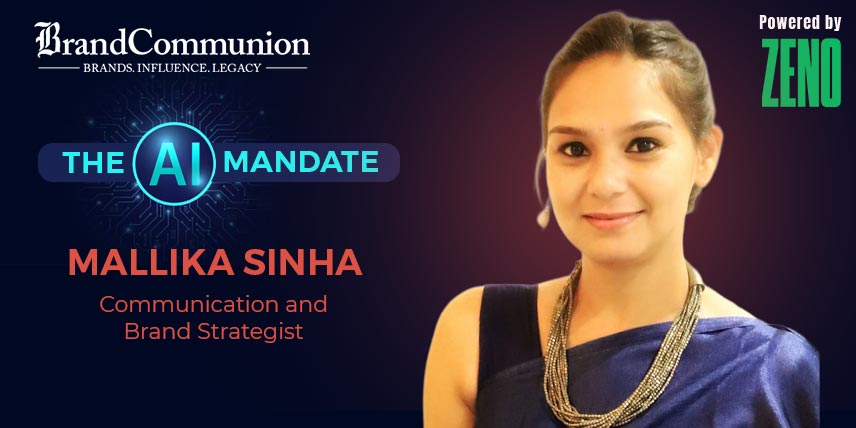
To examine these shifts more closely, we are launching a new editorial series, The AI Mandate. At its core lies a fundamental question: Is AI merely accelerating operational efficiency, or is it fundamentally reshaping how organisations think, lead, and communicate?
As part of this series, we spoke with Mallika Sinha, communication and brand strategist to understand how communications leaders are adapting to and navigating this rapidly evolving landscape.
Edited Excerpts:
Q: Do you see AI merely as an efficiency accelerator, or is it fundamentally reshaping the mandate and mindset of today’s communications leader?
While AI is undeniably an accelerator for drafting, sentiment analysis, and data processing, its deeper impact lies in shifting the mandate of communication leaders. They are evolving from information gatekeepers into architects of trust and strategy.
By leveraging AI to clear the clutter of administrative tasks, communicators can reclaim time for high-level strategy, creativity, and relationship building. Consequently, high-quality communication ensures that leaders act on data-driven perspectives rather than guesswork.
Where communication was once reactive, responding to crises or market shifts AI enables a predictive mindset. By analyzing vast datasets, leaders can now address emerging issues before they break the surface.
Furthermore, AI facilitates personalization at scale. The "one-size-fits-all" mentality has been replaced by a mandate for bespoke messaging, marking a transition from broadcasting to narrowcasting.
This allows leaders to tailor both internal and external narratives for specific, diverse audiences.
Perhaps the most significant shift, however, is the realization that as AI becomes more prevalent, human qualities become more indispensable. Today’s professionals must focus on bridging the gap between what the data reveals and what the human heart needs to hear.
Q: Which function within corporate communications is most susceptible to AI disruption content creation, crisis response, media relations, or reputation intelligence and why?
If we define susceptibility as the space where the traditional human role is shrinking most rapidly, content creation leads the list. Generative AI has commoditized the production of text, imagery, and video; consequently, the human role has transitioned toward final editorial oversight and ethical fact-checking.
Reputation Intelligence also shows high susceptibility to AI disruption. The landscape is shifting from traditional media relations to a digital-first, authentic engagement model. Today, communicators leverage AI-powered sentiment analysis to monitor brand perception in real-time, allowing for immediate course correction.
However, in media relations, AI cannot replace the essence of human connection. While AI excels at automating media lists and drafting initial pitch notes, the personal relationships nurtured over years remain unmatched and vital.
Similarly, during a crisis response, human judgment plays a critical role. While AI provides the speed necessary for sentiment monitoring, scenario simulation, and rapid drafting, the underlying strategy and ethical nuances require human intervention to maintain organizational trust and factual accuracy.
Q: What new skills do communication teams need to remain relevant in an AI-first environment?
Whenever a transformative technology is introduced, it brings both advantages and challenges. To maximize its potential, we must continuously adapt and upskill. While Artificial Intelligence is largely a boon for communication professionals, it is most effective as a strategic tool rather than a replacement for human judgment.
A single AI error can erode brand trust, making communicators essential ethical gatekeepers. While AI can generate content and analyze data, it cannot replace human strengths building trust, managing high-stakes crises, and shaping company culture.
Q: Looking ahead five years, how do you envision AI transforming the structure, skillsets, and influence of corporate communications within organisations?
Five years from now, AI will have evolved from a productivity enhancer into the foundational operating system of corporate communications. The function itself will shift from managing isolated messages to orchestrating a dynamic, interconnected narrative ecosystem.
Within this timeframe, AI will no longer be viewed as an add-on, but as core infrastructure embedded deeply within the profession. The most forward-looking organisations will have moved well beyond pilot projects to achieve full-scale integration, enabling a hybrid workforce where human expertise and automated agents work in tandem to deliver greater speed, precision, and clarity.
At that point, the conversation will no longer centre on human versus artificial intelligence, but on how effectively the two can amplify each other. When that synergy is fully realised, it will mark a truly transformative moment for the communications industry.