

Artificial Intelligence is no longer just another technological trend for communicators to keep an eye on. It has moved to the centre of boardroom conversations across industries embraced with optimism, yet approached with thoughtful caution.
More importantly, AI represents a structural shift in the way reputation is built, interpreted, and amplified.
Its impact will not be uniform. From influencing corporate strategy to reshaping how brands engage with stakeholders, AI calls for sector-specific understanding and carefully governed integration.
To examine these shifts more closely, we are launching a new editorial series, The AI Mandate. At its core lies a critical question: Is AI simply accelerating operational efficiency, or is it fundamentally reshaping organisational thinking and leadership priorities?
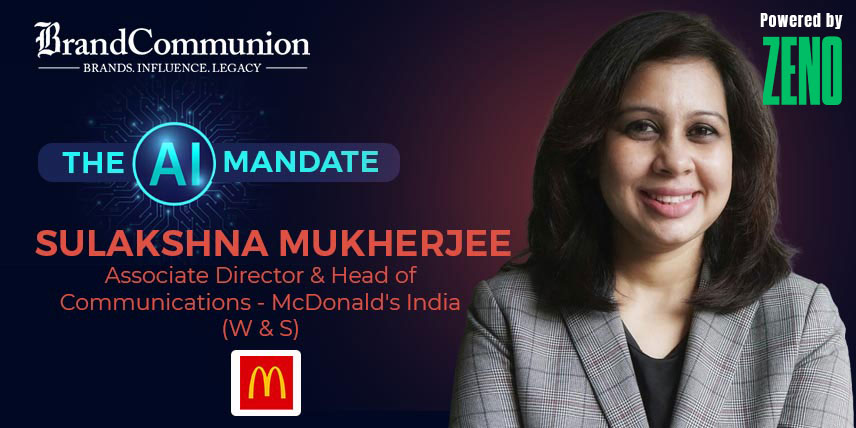
As part of this series, we spoke with Sulakshna Mukherjee, Associate Director & Head of Communications – McDonald’s India (West & South), to understand how communications leaders are adapting to and navigating this rapidly evolving landscape.
Artificial Intelligence is no longer just another technological trend for communicators to keep an eye on. It has moved to the centre of boardroom conversations across industries—embraced with optimism, yet approached with thoughtful caution.
More importantly, AI represents a structural shift in the way reputation is built, interpreted, and amplified.
Its impact will not be uniform. From influencing corporate strategy to reshaping how brands engage with stakeholders, AI calls for sector-specific understanding and carefully governed integration.
To examine these shifts more closely, we are launching a new editorial series, The AI Mandate. At its core lies a critical question: Is AI simply accelerating operational efficiency, or is it fundamentally reshaping organisational thinking and leadership priorities?
As part of this series, we spoke with Sulakshna Mukherjee, Associate Director & Head of Communications – McDonald’s India (West & South), to understand how communications leaders are adapting to and navigating this rapidly evolving landscape.
Edited Excerpts
Q: Do you see AI merely as an efficiency accelerator, or is it fundamentally reshaping the mandate and mindset of today’s communications leader?
Every era has redefined the corporate communication function. Social media made us rapid responders. ESG (Environmental, Social, and Governance) positioned us as corporate conscience. And today, AI is redefining us as architects of trust in an algorithmic world.
It definitely started as an efficiency accelerator, but it is now a lot more. Predominantly, it is helping us move faster by sharper planning, better audience segmentation and more precise narrative tuning. One size fits all communication was never truly effective, and AI is now allowing us to personalise at scale with far greater intelligence.
But the bigger shift is strategic.
Today, communications leaders are becoming intelligence architects, synthesising real-time sentiment, stakeholder behaviour patterns and narrative velocity to guide decisions. At the same time, we are evolving into risk anticipators. AI generated misinformation, deepfakes and synthetic narratives are no longer theoretical threats. We are also at the frontline of digital trust and corporate integrity. The role has expanded into ethical stewardship, shaping AI governance, transparency and disclosure frameworks within our organisations. In essence, role is no longer defined by message management alone. It is being reimagined as a steward of intelligence, trust, and responsibility.
Q: How are you deploying AI across internal and external communications, and have you established a structured toolkit or framework to guide its use?
Our adoption of AI has been gradual and deliberate. For us, the priority is clear that AI should enhance our thinking, not replace it. We are careful not to become lazy communicators who outsource judgment to a tool.
Internally, we are using AI to improve productivity, test narratives and sharpen messaging. It helps us make communication not just faster, but more inclusive and culturally attuned.
Externally, AI is strengthening our media monitoring, tracking narrative velocity and helping us anticipate reputational risks, along with our PR and measurement agencies. It enables sharper audience segmentation and more precise narrative ensuring our outreach is relevant to diverse stakeholder groups, besides being faster.
We are formulating a structured framework that is anchored on three principles: strategic relevance, ethical guardrails and human oversight. We firmly believe that AI is powerful, but creativity, context and conviction must remain human.
Q: With the shift from SEO to Generative Engine Optimisation (GEO), how is your communication strategy evolving to stay visible in an AI-driven discovery ecosystem?
The shift from SEO to GEO is significant and timely. Traditional SEO was about keywords and rankings. GEO is about discoverability, credibility and contextual relevance.
Interestingly, it has brought credibility back to the forefront. Authoritative traditional media and strong owned platforms like company blogs are regaining importance because generative engines prioritise trusted, well cited sources.
Basis this understanding, our strategy is evolving in three ways: First, always-on owned narratives. We are consistently strengthening our owned platforms to shape the primary source material AI engines draw from. Second, we are prioritising verifiable data, authoritative voices and clear ethical disclosure making sure that our content is credible enough to be surfaced and resilient enough to withstand misinformation. Third, machine readable, human resonant communication. Our corporate narratives are structured to align with governance standards while remaining authentic and relatable.
Q: Which function within corporate communications is most susceptible to AI disruption content creation, crisis response, media relations, or reputation intelligence and why?
In my view, AI will gradually impact every function in communications, and the difference will lie in how intelligently we use it.
Currently, the most susceptible to disruption would be content creation. However, that’s not necessarily a threat. AI can draft at speed and scale. The barrier that will collapse is the ability to produce “good enough” content. Volume and velocity will now be easy to mechanise. But here’s the nuance: production is automatable. Judgment is not. AI will generate first drafts, run scenario modelling, track sentiment and sharpen structure. Final decisions like tone, context, cultural sensitivity, ethical balance will require human intelligence and accountability.
Therefore, what AI will replace is undifferentiated output. What it will not replace is strategic narrative framing and responsible leadership. Thus, the future communicator will spend less time producing content and far more time shaping meaning.
Q: What new skills do communication teams need to remain relevant in an AI-first environment?
The most important skill would be strategic judgment. AI will learn from what we feed it. That will make human awareness, context and discernment even more critical. Communicators will have to guide AI intelligently and not allow AI to dictate direction. Only then will communication remain differentiated and impactful.
Beyond that, three capabilities would be non-negotiable. First, data literacy. Teams will have to be comfortable interpreting sentiment analysis, audience segmentation and predictive insights and translate them into narrative strategies. Second, would be AI fluency. Communicators will need to understand how generative platforms surface content, how algorithms influence visibility and how to optimise for discovery in an AI-driven ecosystem. Third and the most important skill would be adaptability.
Teams must be cognizant of the fact that the pace of change is relentless. What works today may be obsolete tomorrow and hence continuous learning is no longer optional.
In parallel, fundamentals like clarity of thought, empathy and ethical grounding will remain timeless. Modern communications teams will have to combine human intelligence with technological fluency. In an AI-first world, relevance will belong to those who will think sharper, learn faster and lead responsibly.
Q: Looking ahead five years, how do you envision AI transforming the structure, skillsets, and influence of corporate communications within organisations?
Five years from now, AI will definitely make corporate communications more central and relevant.
As information overload will intensify, organisations will need leaders who can remove clutter, interpret signals and guide decisions with clarity. That responsibility will sit firmly with communications.
Structurally, teams may become leaner on production and stronger on intelligence, governance and advisory capability. Skillsets will shift toward data literacy, AI fluency and ethical oversight. Those who continuously upskill will remain relevant. Those who don’t will struggle.
Most importantly, AI will elevate our influence. We will move from managing perception to actively shaping corporate integrity and stakeholder trust. Communications leaders will sit at the centre of how organisations engage, govern and earn credibility in an AI-shaped world. So, in the next few years, AI will not dilute our role, rather will amplify it but for those who are prepared to evolve.