

Artificial Intelligence (AI), once limited to technology forums and specialist discussions, is now part of everyday business vocabulary. It features regularly in conversations across boardrooms and industries, generating both optimism and caution. What once seemed futuristic is now influencing how organisations operate, communicate, and make decisions.
Despite the progress, AI is still widely understood through narrow, functional use cases refining text on ChatGPT or generating images on demand. These applications, while visible, represent only a fraction of its broader potential. AI is increasingly shaping decision-making frameworks, business models, and leadership thinking in a digital-first environment.
Its impact will not be uniform. From influencing organisational strategy to transforming audience engagement, AI requires sector-specific approaches and structured integration. Successful adoption demands clarity of intent, defined governance frameworks, and alignment with business objectives.
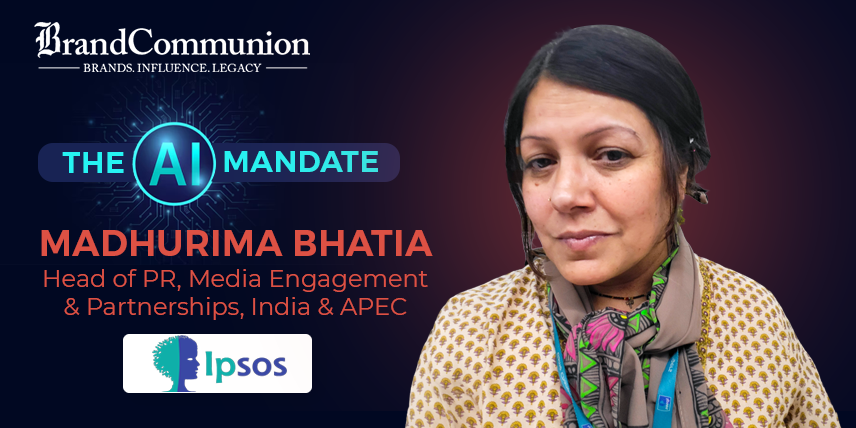
To explore these shifts in depth, we are launching a new series titled The AI Mandate. The series examines whether AI is merely accelerating efficiency or fundamentally reshaping organisational mindsets and leadership priorities.
Are businesses prepared to integrate AI into core operations? Have they built structured roadmaps for responsible adoption? And as digital discovery evolves, how is the traditional Google-led SEO journey gradually transitioning towards ChatGPT-driven GEO (Generative Engine Optimisation)?
The first episode focuses on communications leaders, the custodians of brand reputation and how AI is driving a move from traditional practices to more adaptive, intelligence-led strategies.
As part of this conversation, we spoke with Madhurima Bhatia, Head of PR, Media Engagement & Partnerships, India & APEC (Asia Pacific excluding China), Ipsos India, a market research and consulting firm.
Edited Excerpts
Q: Do you see AI merely as an efficiency accelerator, or is it fundamentally reshaping the mandate and mindset of today’s communications leader?
Artificial Intelligence is quickly becoming a co-pilot in modern communications. When used thoughtfully, the combination of human intelligence and AI can strengthen how stories are developed, refined, and delivered.
For communications leaders, the core elements of strategic intent, institutional knowledge, brand narrative, and contextual judgment must remain human-led. Ownership of message and meaning cannot be outsourced. However, with clear guardrails and disciplined prompt design, AI can improve structure, clarity, and articulation, helping content become sharper and more audience-ready.
AI should not be seen as the author of the story, but as an accelerator. It enhances precision and speed, while the communications leader remains the architect, setting direction, applying insight, and ensuring depth and relevance in every narrative.
Q: How are you deploying AI across internal and external communications, and have you established a structured toolkit or framework to guide its use?
We deploy AI through our proprietary algorithm, Ipsos Facto, built to improve efficiency and outcomes within clearly defined guardrails. Facto supports content development by refining language, improving structure, and, where required, generating high-quality visuals through precise prompting.
It can interpret complex technical material and, in certain cases, produce a strong first draft to speed up the creative process.
Ipsos Facto is designed with embedded safeguards and is integrated with select open-source AI solutions such as ChatGPT by OpenAI and Claude by Anthropic. This approach allows us to leverage advanced AI capabilities while maintaining governance and ensuring that human expertise remains in control at every stage.
Q: With the shift from SEO to Generative Engine Optimisation (GEO), how is your communication strategy evolving to stay visible in an AI-driven discovery ecosystem?
As the digital ecosystem evolves, the focus must move beyond traditional SEO and hashtag-led discoverability towards a more advanced GEO approach. In this environment, content needs to be structured, credible, and context-rich enough to be surfaced and cited by AI-driven platforms.
This shift calls for stronger narrative architecture, authentic storytelling, and clear local relevance, supported by insights drawn from multi-country global studies. The emphasis is on evidence-based thought leadership turning robust data into insights that are meaningful within specific market contexts while remaining globally consistent.
By aligning earned and owned media with a disciplined keyword strategy and semantic depth, organisations can strengthen discoverability, credibility, and long-term engagement across both search engines and generative platforms.
Q: Which function within corporate communications is most susceptible to AI disruption content creation, crisis response, media relations, or reputation intelligence and why?
AI adoption is still at an early stage, especially in strategic communications. At its core, this function must remain human-led, grounded in judgment, contextual understanding, stakeholder sensitivity, and long-term brand responsibility. Strategy, narrative direction, risk assessment, and action planning require experience and accountability and these cannot be delegated to technology.
AI is best positioned as a capable assistant. It can improve speed, deepen analysis, and increase execution efficiency. With clear guardrails in place, it supports research, sharpens messaging, and accelerates output. However, it does not replace strategic thinking.
The model is straightforward: human leadership sets the direction and intent, while AI acts as an intelligent enabler enhancing precision, productivity, and scale without taking over decision-making.
Q: What new skills do communication teams need to remain relevant in an AI-first environment?
At Ipsos, we have formalised AI capability building through a mandatory, certification-based internal training programme. This ensures responsible adoption and consistent standards in how AI tools are used across teams.
As the discipline continues to evolve, there is also a case for industry-wide capability development. Bodies such as the Public Relations and Communications Association of India could consider introducing a structured AI certification for communications professionals, developed in partnership with a leading university. While many academic institutions now offer AI modules, most are broad and technically focused.
Strategic communications requires a more specialised curriculum, one that addresses governance, ethics, crisis simulation, stakeholder engagement, content strategy, and reputation management within an AI-enabled environment. Building this capability at an industry level will help ensure that AI adoption remains responsible, relevant, and aligned with the realities of the profession.
Q: Looking ahead five years, how do you envision AI transforming the structure, skillsets, and influence of corporate communications within organisations?
The future of AI in communications will be shaped by greater operational efficiency, stronger analytics, and faster execution. Automation and intelligent tools will streamline content creation, monitoring, and insight generation, allowing teams to work with more speed and precision.
At the same time, human judgment will remain central. Strategy, ethical oversight, contextual awareness, and stakeholder management will continue to guide communications at a leadership level. AI can strengthen capability and improve output, but direction, accountability, and narrative control will remain firmly human-led.