

As economic uncertainty reshapes consumer behaviour and business priorities, marketers are being asked to deliver far more than brand awareness. They are now expected to drive revenue, demonstrate measurable business impact and play a strategic role in organisational growth.
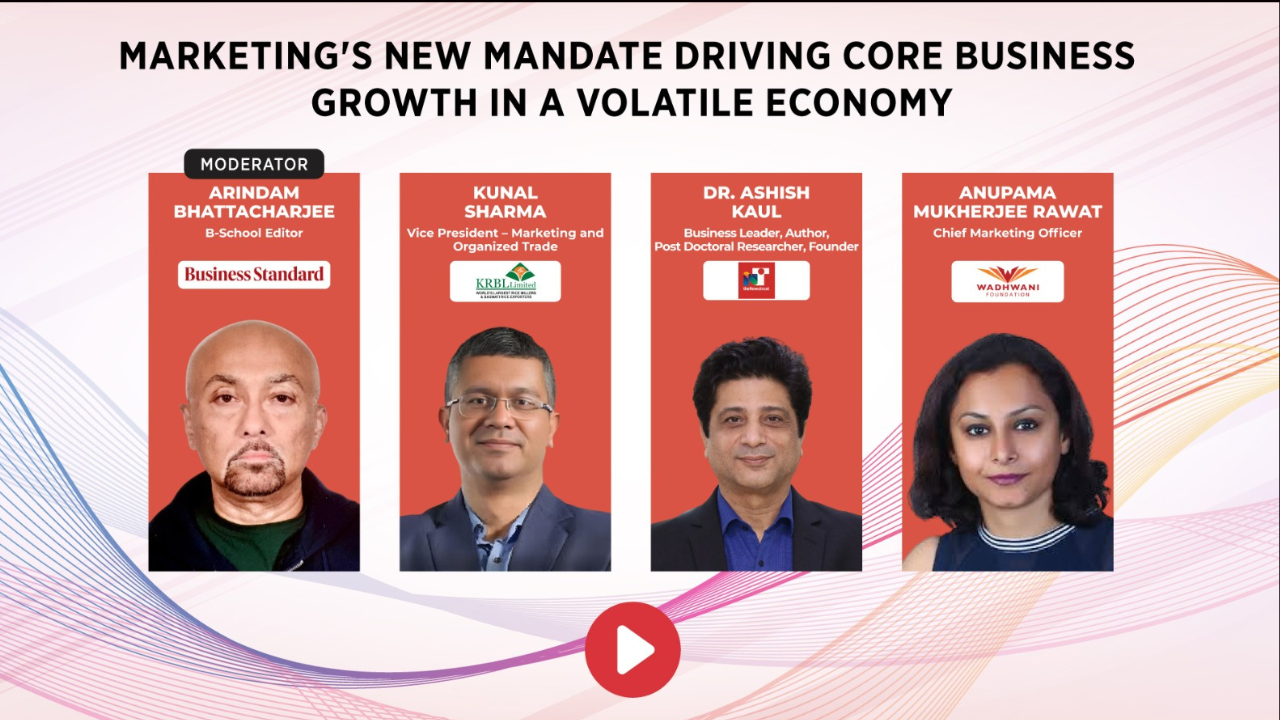
Brand Communion hosted its first flagship event, Convergence 2026. In it, there was a session on the topic, "Marketing's New Mandate: A Growth Playbook for a Volatile Economy", where Dr Ashish Kaul, Managing Editor, NewstrustIndia; Kunal Sharma, Vice President, Marketing & Organised Trade, KRBL and Anupama Mukherjee Rawat, Chief Marketing Officer, Wadhwani Foundation, discussed how marketers can navigate an increasingly volatile business environment.
The session was moderated by Arindam Bhattacharjee, B-school Editor, Business Standard.
Opening the discussion, Dr Kaul argued that marketing in India continues to be driven more by "optics" than business fundamentals. While organisations increasingly speak about convergence and integrated marketing, the real decision-making power often lies outside the marketing function, he said.
"The business fundamental is all about revenue. The optics of it is only one part of it," Kaul observed, adding that marketers are often celebrated for campaigns and creative execution while remaining disconnected from product development, distribution and commercial decision-making.
He further pointed to the industry's weak approach to measurement, saying marketing education has historically paid insufficient attention to measurability.
According to him, marketers continue to focus on advertising execution rather than building capabilities that directly influence business outcomes.
Expanding on the argument, Kaul noted that crucial levers such as product creation and distribution remain outside the marketer's control, with CEOs and sales leaders often making the key commercial decisions.
"The marketer is only dressing up that decision," he said, calling for a broader business orientation within the profession.
Offering an alternative perspective, KRBL's Kunal Sharma said the marketing function is already evolving into the growth engine of organisations.
"The aspiration of marketing as a function is to be the growth driver of the organisation," Sharma said, noting that in several FMCG companies marketers today own category P&Ls and are accountable for revenue alongside brand growth.
He added that the rise of modern trade and quick commerce is accelerating this shift. As newer channels reshape consumer buying behaviour, marketers are taking on greater responsibility for business performance. Sharma argued that the CMO role must eventually evolve into that of a Chief Growth Officer, working alongside the CEO to drive enterprise growth.
Addressing the balance between short-term sales and long-term brand building, Sharma said there is no universal playbook. Instead, brands must first identify the business problem they are solving and define the right metrics for success.
He cautioned against using quarterly revenue as the sole measure of marketing effectiveness, noting that revenue is influenced by multiple factors including supply chain, portfolio strategy and distribution.
Instead, marketing investments should be evaluated against specific brand metrics aligned with their objectives, while avoiding excessive focus on bottom-of-the-funnel performance marketing.
Adding to the discussion, Anupama Mukherjee Rawat said sustainable growth depends on striking the right balance between immediate performance marketing and long-term brand salience.
"Performance marketing is really about immediate revenue, while brand salience drives continued revenue," she said, adding that market leaders are those that successfully balance both approaches.
The conversation also explored artificial intelligence's growing role in marketing. Responding to questions about whether AI could replace strategic thinking, Rawat maintained that while AI significantly improves efficiency and accelerates research, decision-making will continue to remain a human responsibility.
She said AI enables marketers to personalise communication at scale and deliver more customised experiences, particularly in sectors such as education and social impact. However, she stressed that human ingenuity remains irreplaceable.
"AI gives you the speed and efficiency. Human ingenuity and decision-making are not going anywhere," Rawat said.
The discussion concluded with a consensus that marketing's future lies beyond campaigns and communications. As businesses grapple with economic uncertainty, evolving consumer behaviour and AI-driven transformation, marketers will increasingly be judged by their ability to influence business outcomes rather than creative execution alone.