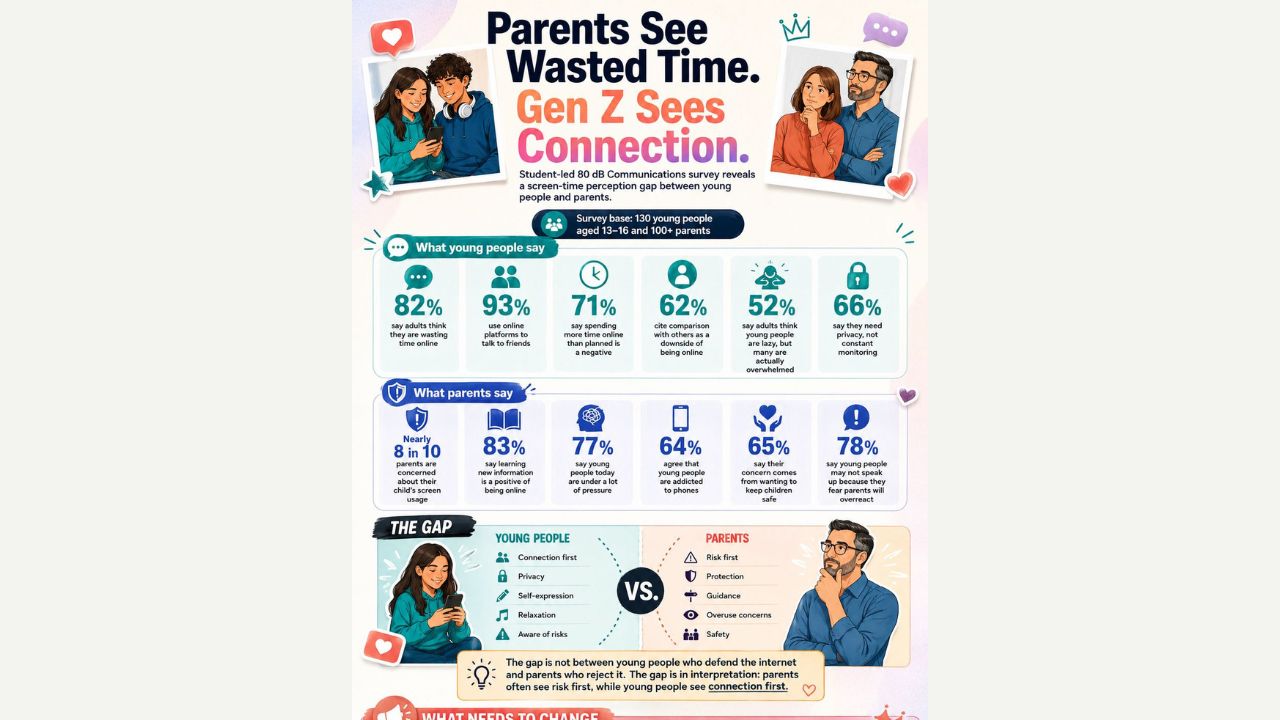


At a time when young people are often spoken about through the lens of screen addiction, distraction and declining attention spans, a new student-led pulse survey by 80 dB Communications suggests that the screen-time conversation may be missing a bigger story: young people and parents are looking at the same digital behaviour very differently.
The survey, More Than Screen Time: What Gen Z and Gen Alpha Wish Adults Understood, was conducted by student interns at 80 dB Communications as part of their internship programme. It captured responses from 130 young people aged 13–16 and 100 + parents, exploring digital behaviour, screen usage, online pressure, cyberbullying, parent-child trust and generational identity.
The findings challenge the easy stereotype of Gen Z as distracted or screen-addicted. Instead, they point to a more balanced generation, one that uses online spaces for friendship, self-expression, learning and relaxation, while remaining aware of the pitfalls of overuse, comparison and online judgement.
The hidden gap in the screen-time debate
For parents, screen time continues to be a source of anxiety. Nearly 8 in 10 parents surveyed said they were concerned about their child’s screen usage. Their concerns are not unfounded: overuse, comparison, cyberbullying, privacy, and online safety emerged as key worries.
But the survey also shows that young people are not romanticising online life. 71% of young respondents said spending more time online than planned is a negative, while 62% cited comparison with others as a downside of being online. This suggests that young people are aware of the risks but want adults to understand that those risks are only one part of their digital experience.
Parents also recognise the positives. 83% of parents identified learning new information as a positive of being online, while other common benefits included entertainment and social connection. The gap is in interpretation: parents often see risk first, while young people see connection first.
It’s not just a distraction. It’s social infrastructure.
While 82% of young respondents said adults think they are wasting time online, their own responses point to a more layered reality. For Gen Z, online life is not just entertainment or distraction; it is where friendships are maintained, ideas are discovered, self-expression takes shape, and the pressures of everyday life are briefly eased.
Talking to friends emerged as the strongest reason young people use digital platforms, selected by 93% of respondents. Other common uses included watching videos or reels, listening to music, schoolwork or learning, and relaxing after school. Many also said they use the internet for learning new skills, connecting with people or doing multiple things online.
Parents, on the other hand, continue to associate screen usage strongly with watching reels or shorts, chatting, distraction and overuse. 65% of parents believed Gen Z online are mostly distracted by watching reels or shorts and chatting. 80% of parents also agreed that young people often spend more time online than planned, leading to concerns around distraction and online addiction.
Lazy or overwhelmed?
One of the strongest emotional findings of the survey was around how young people feel they are perceived. 52% said the statement that felt most true was: Adults think young people are lazy, but many are actually overwhelmed.
This sits against a larger pressure backdrop. 83% of young respondents cited exams and studies as a major source of pressure, while parents’ expectations and body image or appearance also emerged as key concerns. Parents, importantly, do not deny this pressure. Among parents who answered the question, 77% said young people today are under a lot of pressure. At the same time, 64% of parents agreed that young people are addicted to phones.
The finding suggests that what adults may interpret as laziness, avoidance, or distraction may, for young people, also be a way to decompress, stay connected, or manage a demanding everyday environment.
Parents want safety. Young people want privacy.
The survey also highlights a trust gap. When asked what adults should understand better, 66% of young respondents said they need privacy, not constant monitoring. Parents, on the other hand, said they want young people to understand that their concern comes from wanting to keep them safe. 65% of parents selected this, while many also said that although they trust their child, they feel responsible for guiding them.
The trust gap becomes especially important when young people face problems online. 44% of young respondents said they may not speak up about online problems because they fear parents will take away their phone, while others cited embarrassment or fear that the situation may get worse. Parents recognise this too: 78% said young people may not speak up because they fear parents will overreact.
Both sides are asking for trust, but in different languages. Young people experience monitoring as judgement. Parents see it as protection.
The change needed: from screen-time control to digital trust
The survey suggests that the conversation around young people and screens needs to move from control to understanding. Instead of treating every minute online as a distraction, families and schools may need to talk more openly about why young people go online, what they experience there, and how to make digital spaces safer without breaking trust.