

Advertisements created using generative artificial intelligence can perform just as effectively as those produced by humans, according to a large-scale academic study that analysed more than 500 million digital ad impressions from live campaigns.
The research, conducted on Taboola’s performance advertising platform Realize, was carried out in collaboration with scholars from Columbia University, Harvard University, the Technical University of Munich and Carnegie Mellon University. The dataset included hundreds of thousands of advertisements that together generated over three million clicks.
AI and human ads show similar click-through rates
After applying statistical controls, researchers found that AI-generated ads achieved click-through rates comparable to those created by human designers.
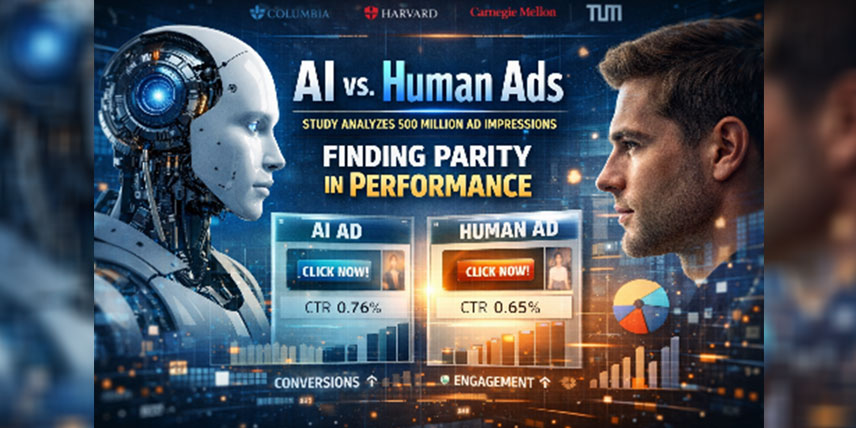
In the raw, unadjusted data, AI-produced creatives recorded a slightly higher average click-through rate of 0.76 per cent, compared with 0.65 per cent for human-made advertisements.
The findings challenge the widespread assumption that machine-generated creative content is inherently less persuasive or engaging than human work.
Human-like design drives stronger engagement
One of the study’s central insights was that AI-generated ads perform best when they do not appear overtly artificial.
Creatives that were perceived as more “human-like” delivered higher engagement levels than both clearly AI-styled visuals and traditional human-designed ads.
Large, clearly visible human faces emerged as one of the most powerful trust signals across campaigns. The research found that AI-generated ads were more likely to include such visual elements than human-created creatives, partly due to platform guidelines and widely adopted creative best practices.
No negative impact on conversions, study finds
Beyond click performance, the researchers also examined downstream results and found that AI-generated ads did not reduce conversion effectiveness, suggesting that advertisers can scale creative production using AI without compromising campaign outcomes.
Early adoption of AI-driven ad creation was most prominent in categories such as food and beverages and personal finance, where brands frequently test multiple creative variations at scale.
Researchers highlight real-world data advantage
Oded Netzer, Vice Dean for Research at Columbia Business School, said the collaboration with Taboola offered rare access to large-scale, real-world advertising data.
“Taboola’s platform gave us a literal gold mine of real-world data that simply cannot be replicated in a laboratory environment. By examining more than 500 million impressions, we were able to move beyond the hype surrounding generative AI and measure its true impact at scale,” Netzer said.
“Our results show that when AI is used to strengthen human cues — such as the sense of trust created by a human face — it doesn’t merely match human performance, it can even raise the ceiling for engagement,” he added.
Methodology isolates creative origin
To ensure reliable comparisons, the study employed a quasi-experimental approach known as “sibling ads”. This method compared AI-generated and human-designed creatives produced by the same advertiser, for the same campaign, and released on the same day.
By holding constant factors such as audience targeting, campaign timing and landing pages, researchers were able to isolate the effect of creative origin on performance outcomes.
The findings are expected to influence how advertisers, agencies and platforms evaluate the role of generative AI in creative strategy, as brands increasingly look to balance efficiency, scale and audience connection in digital marketing.