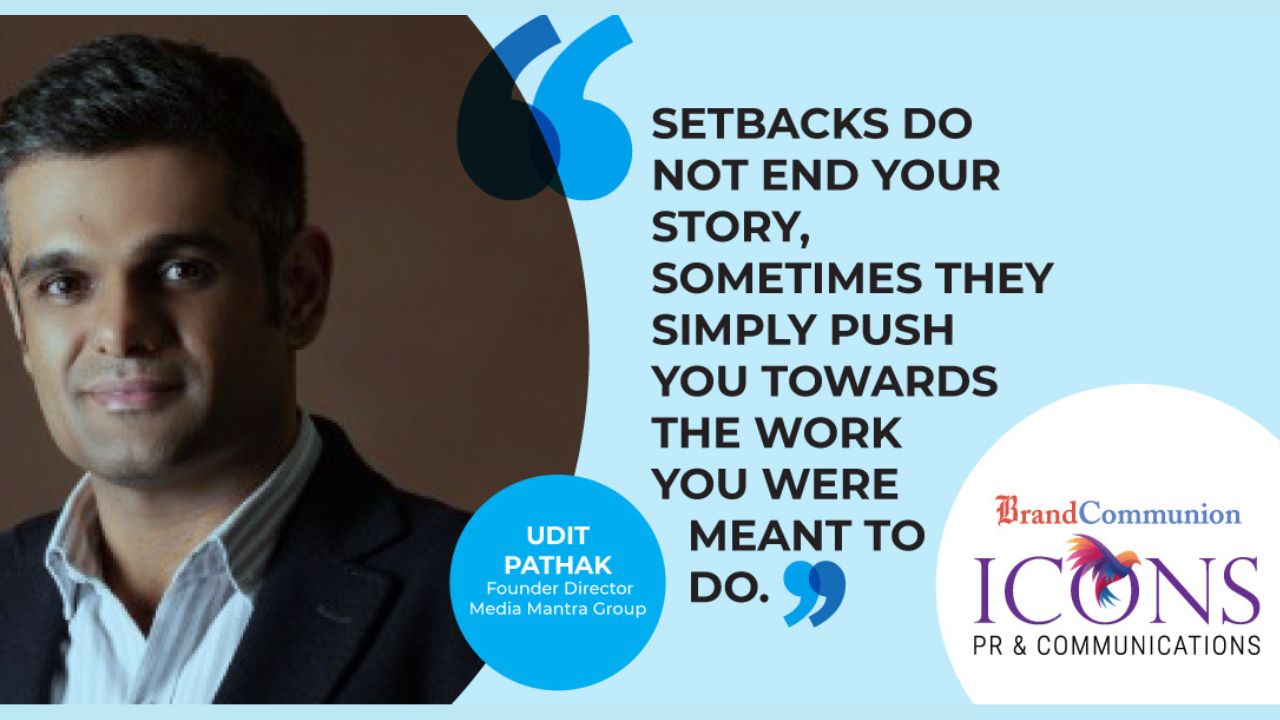


From navigating personal adversity to building a globally expanding communications firm, Udit Pathak’s journey is a story of resilience, conviction, and steady growth.
As the Founder Director of Media Mantra Group, Pathak has witnessed the evolution of the PR industry firsthand,moving from traditional media relations to integrated, data-driven communication strategies. In this candid conversation, he reflects on his early struggles, defining moments, industry shifts, and the lessons that continue to shape his approach to leadership and PR today.
Edited Excerpts:
Q1. How did your journey in PR begin? Was it a conscious career choice or something you attribute to chance? Did your parents understand and support your decision at the time?
When I started working, PR wasn’t even on my radar. I came from a family that had been in the crockery business for decades, but changing markets and rising imports led to its decline. I remember conversations at home about bills and uncertainty, while my mother would always say, “Study hard and stand on your own feet.” That stayed with me.
I began with a news channel and later moved to a PR firm, where things finally clicked. I saw how a single well-placed story could transform how a company was perceived. Early on, I worked with a small client no one knew; after one strong media story, people started reaching out to them instead. That’s when I realised the real value of PR.
My parents didn’t fully understand the field then, but they trusted me and that was enough.
Q2. What would you consider your defining moment or breakthrough in the industry?
For me, that moment came when we started Media Mantra Group. In the early days, it was just one other person, a small office, and big hopes. I handled everything, from client meetings and writing press notes to following up with journalists.
One early client pitch still stands out. We were up against much bigger agencies and didn’t seem to stand a chance. But we took the time to truly understand the client and spoke with honesty and conviction and won. That became our way of working: PR was never just about sending press releases, but about understanding the business first.
Years later, growing to 150+ people, expanding across cities, and opening an office in Dubai felt special not because of the scale, but because it proved that something built from scratch could stand alongside the best.
Q3. Can you tell us about the toughest phase in your career and what that period taught you?
The hardest phase was watching my family business shut down while I was trying to build my own career. Seeing financial stability turn into uncertainty created pressure to earn, support my family, and prove myself.
There were days I worked nonstop and still wondered if it was enough. I’d travel across the city for meetings without knowing if a client would sign. It’s a phase many in PR go through,working hard behind the scenes with little visibility.
That time taught me that success doesn’t come quickly, and tough phases make you stronger. Today, when young people at Media Mantra Group feel overwhelmed, I remind them that these moments don’t last. What matters is how you respond to them.
Q4. How have you seen PR evolve from when you started to today’s digital-first world? What are some key changes that stand out to you?
When I started, PR was largely about securing print coverage, success meant how many articles you got and where.
The shift to digital changed everything. Social media gave brands direct access to audiences, but also made crises spread within minutes. Over time, the scope of PR expanded significantly. Today, it spans digital PR, performance marketing, video content, brand building, crisis management, and more, often all at once.
Clients now expect integrated communication strategies, not just media coverage. Data has also become central, with real-time tracking of reach, sentiment, and engagement making PR more accountable and respected.
With Media Mantra now operating in Dubai and across the MENA region, it’s clear that Indian PR firms are competing on a global stage, something I couldn’t have imagined early in my career.
Q5. What is one piece of advice you would give to someone just entering the PR industry? And if given the chance, would you still choose a career in PR today?
The one thing I’d tell someone starting out is to be consistent, especially when things aren’t going well. Passion and creativity matter, but what truly sets you apart is showing up every day with the same commitment. PR is a relationship-driven business, and people remember who stayed reliable when things got tough.
Patience is equally important. Results don’t come overnight, you build credibility and trust over time, and there are no real shortcuts.
Would I choose PR again? Without a doubt. It has offered incredible variety, constant challenges, and the chance to work across industries. Seeing Media Mantra grow from a one-person setup to an international company only reinforces that it was the right choice.
Q6. What is one common misconception about PR that you would like to correct?
The biggest misconception is that PR is just about getting your name in the newspaper. That thinking is still common, even among senior leaders. In reality, communication shapes everything from employee perception to investor confidence and crisis response.
At Media Mantra, the work goes far beyond media coverage. It includes public relations, crisis management, digital PR, brand development, and performance marketing,far more than just pitching stories.
Another myth is that PR isn’t measurable. While that may have been true earlier, today data plays a central role. Metrics like share of voice, sentiment, and audience reach directly link communication efforts to business outcomes. PR has evolved into a strategic function at the leadership level, not just a support role.
Q7. Where do you see the PR industry heading in the next five years?
A few key shifts will define the industry going forward.
AI will transform how content is created and distributed, but it will also increase the value of human judgement and real relationships, things technology can’t replace. Integration will become the norm, with clients expecting PR, performance marketing, and digital strategy to work as one connected approach.
Global expansion will accelerate, especially for Indian firms that can balance cross-border scale with local understanding. And proactive reputation management will become essential because in today’s fast-moving environment, you can’t wait for a crisis to act.
The next five years will reward firms that are bold, credible, and truly strategic.
Q8. If your PR journey had a headline, what would it be?
"From life's adversity to the World's Stage: The Incredible Journey of Udit Pathak"
That one line captures it all for me because it connects both parts of my life. I grew up watching my family business struggle and eventually shut down. Years later, I found my own path in PR and built Media Mantra Group from a small office into a company that now works with businesses across India and overseas.
It reminds me that setbacks do not end your story. Sometimes they simply push you towards the work you were meant to do.
And if there was a subheading, it would simply be, "Because hard work was always the only strategy."