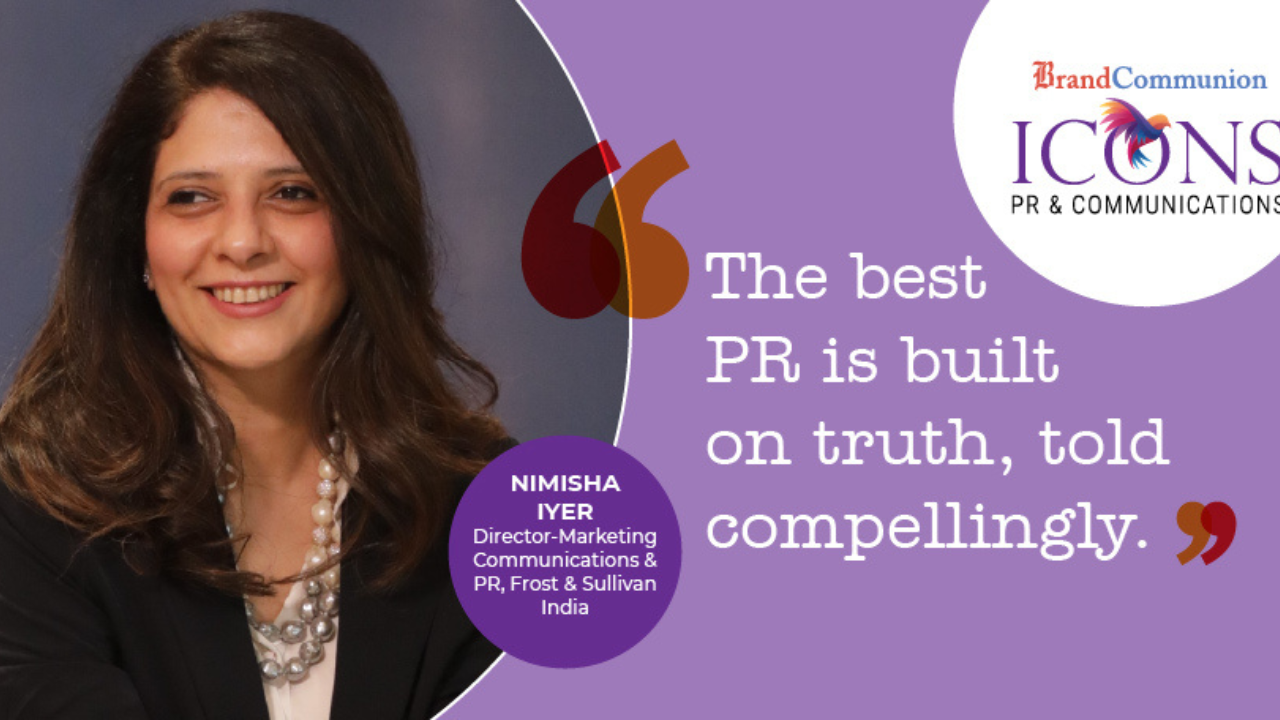


For Nimisha Iyer, Director-Marketing Communications & PR, Frost & Sullivan India, a career in public relations was neither entirely planned nor purely accidental. What began as a shift from commerce to advertising and PR eventually evolved into a career shaped by agency experience, corporate communications and even entrepreneurship.
In the latest series of PR Icon, Iyer looks back at the experiences that shaped her approach to communications, from her early days at IPAN PR, which later became Hill+Knowlton Strategies, to roles at Cushman & Wakefield and Frost & Sullivan. She also reflects on stepping away from a senior corporate role to co-found healthy food subscription brand The Diet, an experience she says gave her a founder's perspective on building trust and understanding commercial outcomes.
Iyer believes the PR industry has moved from a world focused largely on reach and media placements to one where relevance, authenticity and business impact matter more. She argues that communicators need to understand the industries and commercial realities of the organisations they represent, rather than limiting themselves to writing and pitching.
Looking ahead, Iyer expects PR, content and digital strategy to become increasingly intertwined, while AI takes over more executional work. In her view, strategic thinking, relationship intelligence and crisis judgement will become increasingly valuable, while data and measurement will play a larger role in demonstrating PR's business impact.
Edited Excerpts:
Q: How did your journey in PR begin? Was it a conscious career choice or something you attribute to chance? Did your parents understand and support your decision at the time?
Honestly, it was a little of both. I was doing my B.Com at Sydenham and I knew early on that numbers weren't where my heart was - I was always the person who wanted to tell the story behind the numbers. A PGDM in Advertising and PR at Welingkar's felt like the natural pivot, and the moment I stepped into that programme, something just clicked.
My first role at IPAN PR - which later became Hill+Knowlton Strategies - confirmed that this was my world. It was a brilliant first school with great mentors. I was doing competitive benchmarking, dealership comparisons, getting into the granular details of how a brand actually lives on the ground, getting consumer experience stories for an FMCG brand, the usual press conferences and follow-ups. It wasn't glamorous work all the time, but it was real work.
Cushman & Wakefield took me deeper - more product-focused, higher-quality client engagement, and a much sharper understanding of stakeholder communications in a professional services environment. By the time I came to Frost & Sullivan, something had crystallized for me quite early: communications isn't just about brand awareness. It never was. The real game is weaving brand with business outcome - making sure every story you tell is also moving something forward commercially, not just building impressions.
That realization, honestly, changed the way I've approached every brief since.
As for my parents, they were supportive, but my dad had his heart set on me becoming a doctor and was disheartened when I took up commerce. And I won't pretend there wasn't that classic Indian household moment. PR wasn't as established or understood back then as it is now. But they trusted me, and I think seeing me find my footing quickly at IPAN put them at ease. That early backing meant a lot.
Q: Can you tell us about the toughest phase in your career, and what that period taught you?
Stepping away from a senior corporate role to build something from scratch - that was the hardest and most humbling thing I've done. When I co-founded The Diet, a healthy food subscription brand, I went from being the person with a team and an established brand behind me, to being the person planning daily menus, packing orders, acquiring and handling customer requests, doing my own SEO, website, and figuring out tax compliance. There's no safety net when you're bootstrapped.
But what it taught me is irreplaceable. It gave me a founder's lens - I stopped thinking about communications as "campaigns" and started thinking about it as building trust, one touchpoint at a time. When I returned to Frost & Sullivan, I brought that commercial instinct with me. I think it made me a far better MarComm leader.
Q: How have you seen PR evolve from when you started to today's digital-first world? What are some key changes that stand out to you?
When I started out, there was information overload - but not quite at the scale we see today. In some ways our era was both easier and harder: fewer channels, but every placement had to count. You had to be genuinely selective and strategic about what you put out, because you didn't have the luxury of volume.
What's fundamentally different today is that relevance has replaced reach as the real metric. You don't need a massive budget or a big-name face for your brand anymore. If your story is real, if it's genuine, it will find its audience. Journalists today - and audiences - can read through manufactured narratives almost instantly. The craft of authentic storytelling has never mattered more, and the tolerance for fluff has never been lower.
Online reputation management has also become central in a way it simply wasn't before. A brand's perception is no longer shaped only by what it puts out - it's shaped equally by what others say, share, and amplify. That's a profound shift. The communicators who understand that real connections and genuine narratives are the most powerful tools in the kit - those are the ones winning today.
Q: What is one piece of advice you would give to someone just entering the PR industry? And if given the chance, would you still choose a career in PR today?
Be genuinely curious about the businesses and sectors you work in. PR professionals who only know how to write or pitch but don't deeply understand what their organisation does plateau early. Invest time in understanding the commercial reality, the industry dynamics, the challenges your leadership is trying to solve. That's what separates a good communicator from a strategic one.
And yes, absolutely, I'd choose PR again. But I'd tell my younger self to ask for a seat at the strategy table earlier. Don't wait to be invited.
Q: What is one common misconception about PR that you would like to correct?
That PR is about spin - about making things look better than they are. That framing has done the industry a real disservice. The best PR is built on truth, told compellingly.
Our job is to find the authentic story or a perspective - and it could be a different one from what most believe - and make sure it reaches the right people in the right way. The professionals I respect most in this field are the ones who push back on their own leadership when necessary. That credibility is the foundation of everything.
Q: Where do you see the PR industry heading in the next five years?
I think we'll see the lines between PR, content, and digital strategy continue to blur - and that's actually a good thing for professionals who are willing to evolve. Data and measurement will become non-negotiable; the days of justifying PR value through estimated reach are numbered.
AI will handle a lot of the executional workload, which means the premium will shift to strategic thinking, relationship intelligence, and crisis judgment - things that can't be automated.
For B2B specifically, I see thought leadership becoming the primary currency. Organisations that can position their leaders as genuine voices in their industries - not just mouthpieces - will have a real competitive edge.
Q: If your PR journey had a headline, what would it be?
"Figured It Out as She Went - And Wouldn't Change a Thing."