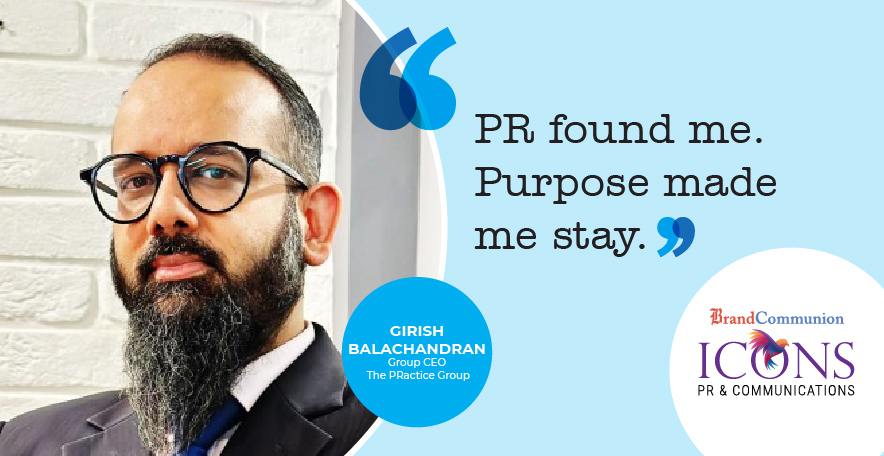


For Girish Balachandran, Group CEO, The PRactice Group, a career in public relations was hardly part of a conventional plan. Before entering communications, Balachandran studied History, worked as a chef across India and Kuwait, and at 25 found himself leading a catering operation serving 10,000 US soldiers at Baghdad International Airport during the second Gulf War.
His eventual move into PR came through an MBA in the UK, where an Omnicom firm sponsored his dissertation and subsequently offered him a role.
In the latest edition of PR Icon, Balachandran reflects on a career spanning global communications roles at organisations including Ketchum, Waggener Edstrom and Avian Media, before he stepped away from a senior leadership position in 2017 to found ON PURPOSE.
Balachandran also opens up about one of the most challenging periods of his career, the sudden shutdown of USAID in 2025, which significantly impacted the business and the lessons it reinforced around financial resilience, client diversification and leadership.
He discusses how PR has evolved from a media-gatekeeper-led profession to one shaped by fragmented audiences, faster news cycles and employee activism, arguing that internal communications has increasingly become a critical part of reputation management.
Edited Excerpts:
Q: How did your journey in PR begin? Was it a conscious career choice or something you attribute to chance? Did your parents understand and support your decision at the time?
Honestly? PR was about the fifth thing I tried. I dropped out of St. Stephen's, where I was studying History, because I wanted to do something unconventional. I became a chef. My first kitchen was Gallopin' Gooseberries in Thiruvanmiyur, Chennai, a place as wonderfully eccentric as its name. That career took me from Chennai to Lucknow to Kolkata to Kuwait, and eventually to Baghdad, where at 25, I found myself leading a catering operation for 10,000 US soldiers at Baghdad International Airport during the second Gulf War. My mother later revealed that my grandmother was half Iraqi. So, in a strange way, it was a homecoming.
PR found me through an MBA in the UK. An Omnicom firm sponsored my dissertation on how small, knowledge-intensive firms from high-tech clusters like Cambridge go global. They offered me a job. I said yes, not entirely knowing what I was walking into. But I quickly realised that communications, like cooking, is fundamentally about people. What they need. What they feel. What moves them. The instincts weren't so different.
Did my parents understand? They’re the type that quietly worry and loudly support, often in the same breath. I think they were just relieved I'd come back from Baghdad.
Q: What would you consider your defining moment or breakthrough in the industry?
Rising to Board Director at Ketchum's UK office was a milestone, certainly. But my real breakthrough wasn't a promotion. It was a decision.
In 2017, after over a decade in global PR with Ketchum, Waggener Edstrom and Avian Media, I walked away from a well-paying leadership role to found ON PURPOSE on a single, stubborn belief: that communications had to stand for something good. Not just be good at what it does but stand for something.
That decision felt naive to some. It still does, occasionally, to me. But today, we work with organisations, UN bodies, Foundations, corporates and non-profits representing some of the world's most marginalised and under-represented communities. Through our work, we try and bring more diverse voices and representation on issues like climate, health, education and gender. That is our breakthrough.
Q: Can you tell us about the toughest phase in your career, and what that period taught you?
The sudden shutdown of USAID in 2025. They were our largest client, and we were deep in delivery, supporting their work in accelerating the clean energy transition across six countries in South Asia. The shutdown came without warning, without an orderly wind-down, and with significant money still owed to us.
We had teams invested in the work. We had to right-size the organisation, quickly. But our non-negotiable was dignity, both for every single person we had to let go, and for every person who stayed.
I am proud of one thing above everything else from that period: we never delayed a salary. Not once. No matter how stretched our own finances, no matter the unpaid invoices. The people who worked with us deserved that, at the very least.
What it taught me is painfully simple: build financial guard rails before you need them. Diversify your client base even when one client feels safe. And surround yourself with people whose loyalty, when tested, leaves you genuinely humbled. Ours did.
Q: How have you seen PR evolve from when you started to today's digital-first world? What are some key changes that stand out to you?
The biggest shift is from gatekeepers to echo chambers. When I started, we had ten key journalists in a sector. Own the relationship, own the story. Today, a single reel from a 19-year-old in their bedroom, or a tweet from a US President in a bad mood, can move markets faster than a front-page Wall Street Journal article.
Three changes stand out to me. First, speed over perfection. We used to have hours to craft a statement. Now we have minutes. The goal isn't a perfect response, it's a fast, right, and human one.
Second, audience fragmentation. You can no longer send one message to 'the public.' You send a hundred messages to a hundred micro-communities on LinkedIn, Discord, and WhatsApp, and each of them can smell inauthenticity from a mile away.
Third, and perhaps most underestimated: the rise of internal PR. With employee activism and distributed work, our biggest audience, and our biggest reputational risk now sits inside our own firewall. Culture communications are the new crisis communications.
Q: What is one piece of advice you would give to someone just entering the PR industry? And if given the chance, would you still choose a career in PR today?
Learn to love the business of our client as much as the story of our client. Don't just be a great writer. Be the person who understands their P&L, their supply chain, their biggest competitive fear. That's how we move from vendor to trusted advisor, and that's where the real work begins.
And yes, I would choose PR again. In a heartbeat. Where else do you get to be a psychologist, an OTP -giver, a data scientist, a firefighter, and a storyteller, all before 10 AM? It's chaotic, often thankless, and regularly humbling. But there is no greater privilege than helping a good organisation find its voice or helping a struggling one find its way back.
Q: What is one common misconception about PR that you would like to correct?
That we 'control the narrative.'
Let me be direct: no one controls the narrative anymore. Not the CEO, not the government, not the world's most well-resourced agency. The audience controls the narrative. Our job is not to spin or suppress. It is to navigate, to listen for where the conversation is heading, identify the most honest path through it, and advise our clients on whether the moment calls for speech, action, or the discipline of silence.
Q: Where do you see the PR industry heading in the next five years?
Two directions, simultaneously: hyper-analytical and hyper-human.
AI will absorb the majority of tactical work, media monitoring, first drafts, reporter matching, sentiment mapping. The entry-level role will shift from writing pitches to training and refining the models that write them.
But the premium will move decisively toward what AI cannot replicate: gut instinct, emotional intelligence, the ability to sit with a grieving stakeholder or an angry activist and say something real. The strategic courage to look a powerful client in the eye and say, clearly, 'That is a terrible idea.'
The winners in five years won't be the best writers or the best coders. They'll be the best translators, people who can bridge the gap between what the data says and what the human heart actually feels.
Q: If your PR journey had a headline, what would it be?
"From the Kitchen to the Boardroom to the Margins, Still Cooking."