

Public relations has moved far beyond managing media narratives. For Nitin Thakur, Group President – Strategic Initiatives, PRISM, the profession is ultimately about understanding businesses, earning trust, and having the judgement to guide organisations through moments of uncertainty.
In the latest edition of PR Icon, Thakur looks back at a career that began in 1999 and has taken him through communications leadership roles at organisations including Microsoft, Max Group, OYO and PRISM. He reflects on the crises that shaped his approach to reputation management, how the communications landscape has changed in the digital-first era, and why PR professionals need to understand the business before attempting to communicate it. Thakur also discusses the growing role of AI, the need for communications to move upstream into boardroom and business strategy conversations, and why the most effective PR is rooted not in spin, but in honest and often uncomfortable counsel.
Edited Excerpts:
Q1. How did your journey in PR begin? Was it a conscious career choice or something you attribute to chance? Did your parents understand and support your decision at the time?
I wouldn't call it a plan. It was more like a pull, a curiosity about how the world made sense of things, how stories got told, who got to tell them. When I was starting out, I didn't have a map for this industry. PR wasn't a well-trodden path the way law or medicine was. I was figuring it out in real time, picking up threads, following instincts, learning by being in the room.
What I did have was a deep fascination with communication as a force. Not just messaging, but the underlying mechanics of how perception is built, how trust is earned, how a narrative can shift the temperature in a room. That curiosity kept pulling me forward.
As for my parents, they were supportive in the way parents are when they trust you even if they don't fully understand the territory. "What exactly is it that you do?" was a question I fielded for years. But they could see something was working. Over time, the results became the explanation I could never quite put into words.
Looking back, I think what really happened is that this industry found me as much as I found it. It gave me a home, intellectually, professionally.
Q2. What would you consider your defining moment or breakthrough in the industry?
There wasn't a single moment. There was a period and it came at PRISM (parent of OYO), during what were arguably the most scrutinised years in the company's history. The organisation was navigating rapid global growth, a pandemic, a restructuring, intense public and media attention across multiple markets simultaneously. Every communication decision carried outsized consequence.
What that period demanded of me and gave me was a different kind of clarity. When the margin for error is near zero, you stop performing reputation management and start practising it. You learn to see around corners. You learn that a story isn't something you impose on a situation; it has to be earned, sentence by sentence, action by action.
Q3. Can you tell us about the toughest phase in your career, and what that period taught you?
Crisis has been a constant companion across my career, that's not a complaint, it's simply the reality of working in reputation for decades across sectors as varied as healthcare, technology, financial services, and hospitality. Each one taught me something. Together, they've shaped how I think.
But if I'm honest about the toughest phase, it was the convergence of multiple crises at once. There have been periods where I was managing reputational fires across markets simultaneously, where the pace of information outran every playbook I had. In those moments, you can't rely on process. You have to rely on judgment.
What those years drilled into me is this: the goal in a crisis is not to extinguish it quickly. The goal is to respond honestly, consistently, and with a steadiness that the people around you colleagues, stakeholders, the public, can anchor themselves to. Panic is contagious. So is calm. Your job as a communications leader is to be the calm.
The other thing I've learned and this took years is that the best crisis management happens long before the crisis. It's the relationships you've built, the credibility you've established, the way you've consistently told the truth in good times that determines whether anyone believes you when things go wrong. Preparation isn't a checklist. It's a posture.
Q4. How have you seen PR evolve from when you started to today's digital-first world? What are some key changes that stand out to you?
When I started PR in 1999, a well-placed story in a leading national daily could shape a week's conversation. The media landscape was concentrated. Relationships were long-term. The pace of news allowed for reflection.
Today, that same story can be amplified, distorted, fact-checked, and archived all within the hour. The speed is extraordinary. The complexity is even more so.
What stands out to me most isn't the technology though. It's the audience. The people on the other side of every communication today are sharper, more sceptical, and far less forgiving of inauthenticity than any audience I worked with in my early years. They've seen too much spin. They can smell a managed narrative. That has raised the bar for everyone in this profession in ways I find genuinely exciting.
The craft itself, the ability to tell a true story well, to build trust brick by brick, to be the steady voice in turbulent conditions, that hasn't changed. What's changed is the arena. It's faster, louder, and more unforgiving. But the fundamentals still hold. They always do.
I think of something Aristotle noted, that the art of communication is not in having words, but in having the right words at the right moment.
Q5. What is one piece of advice you would give to someone just entering the PR industry? And if given the chance, would you still choose a career in PR today?
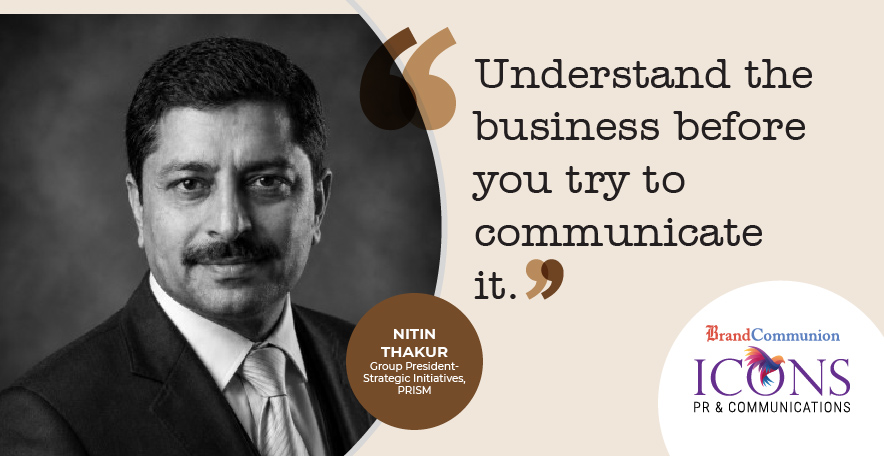
Understand the business before you try to communicate it.
This sounds simple. It isn't. Too many early-career professionals reach for the message before they've genuinely grasped the substance. They want to craft the narrative without sitting in the rooms where the decisions are made. But communication that isn't rooted in deep organisational understanding is, at best, surface. At worst, it's noise.
My advice is to be insatiably curious about the business you serve. Ask the uncomfortable questions. Understand what the organisation fears, what it's building toward, where it's fragile. Only then do you earn the right to speak for it and only then can you do it with conviction.
As for whether I'd choose this again, without hesitation. Every day in this field is different. Every crisis teaches you something new about human nature, about how institutions behave under pressure, about what people actually value when the easy answers run out. I've worked in boardrooms and briefing rooms, navigated global crises and strategic pivots, and I still find the work genuinely alive.
There's a line I return to often, George Bernard Shaw once observed that the single biggest problem in communication is the illusion that it has taken place. This profession exists precisely to close that gap. I can't imagine a more meaningful place to spend a career.
Q6. What is one common misconception about PR that you would like to correct?
That we manage spin.
It's the misconception that frustrates me most, and it persists because it carries a grain of historical truth, there was a period in the profession's evolution where some practitioners did operate that way. But conflating that with what communications leadership actually is today is like judging medicine by its worst practitioners.
The most effective work I've done across decades at Microsoft, at Max Group, at OYO and now at PRISM, has been built entirely on truth. Told with clarity, told with courage, told in a way that serves long-term trust rather than short-term optics. In my experience, when an organisation tries to manage a narrative that isn't grounded in reality, the fracture is always visible. Audiences today are too informed, and journalists too rigorous, for constructed realities to hold.
What PR done right actually is: counsel. Strategic, honest, often uncomfortable counsel. Advising a CEO before they speak, not just after. Being in the room when decisions are made, not just when they need to be communicated. Helping an organisation understand how its actions are perceived and sometimes, pushing back on the actions themselves.
That is not spin. That is the opposite of it.
Q7. Where do you see the PR industry heading in the next five years?
The lines between communications, policy, and business strategy will blur almost entirely and I think that's overdue.
For too long, PR has been treated as a downstream function. Something you call in after the decisions are made. What I see and what I've been working toward in my own career, is communications leadership moving upstream. Into the boardroom. Into the strategy conversation. Not as execution, but as counsel at the point of decision.
AI will reshape a significant portion of what we do operationally monitoring, distribution, synthesis, even first-draft content. Those who resist this are fighting the wrong battle. But what AI cannot replicate is judgment the ability to read a room, to weigh an ethical dimension, to advise a leader in a moment of genuine uncertainty. That human dimension of the craft will become more valuable, not less.
What I also believe is that reputation will increasingly be treated as a balance sheet item. Intangible, yes, but with very tangible consequences. Organisations that understand this will invest in communications leadership differently. Those that don't will be reminded of its value the hard way.
The professionals who will define the next decade in this industry are those who can hold complexity who understand business, policy, culture, and technology simultaneously, and can translate between them. I find that deeply exciting.
Q8. If your PR journey had a headline, what would it be?
Rode Into Every Storm. Rode Out Wiser