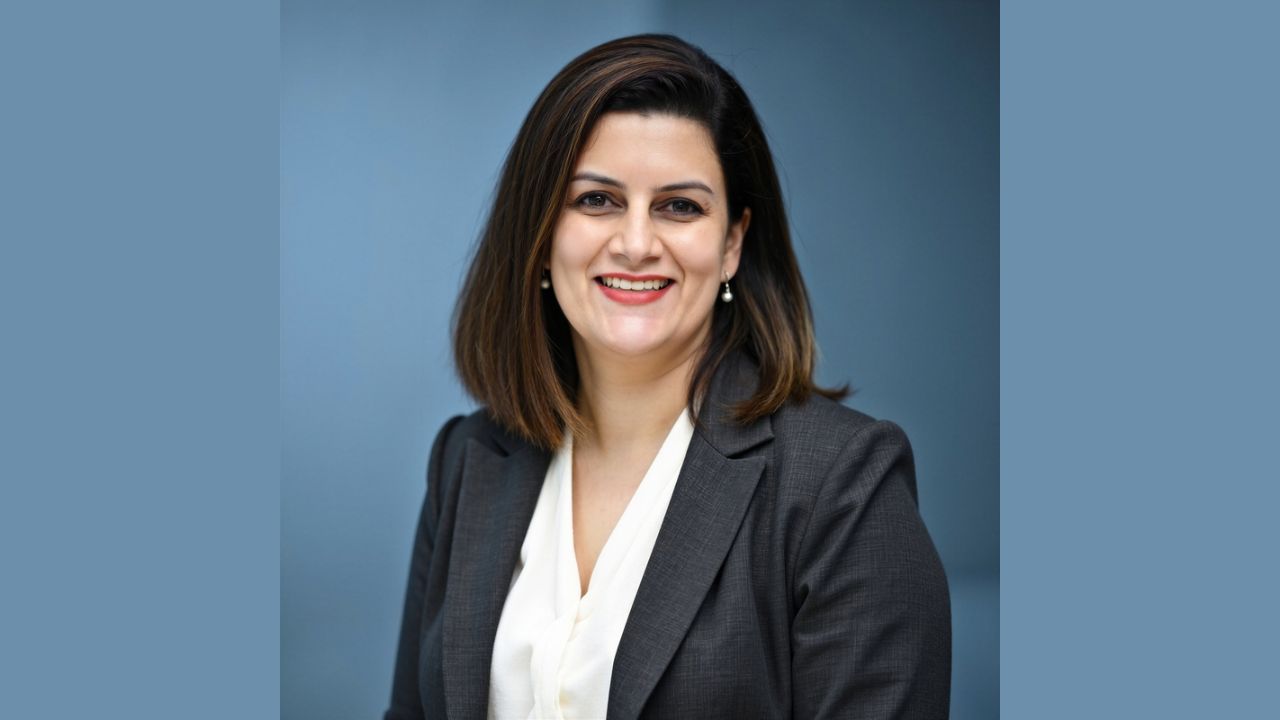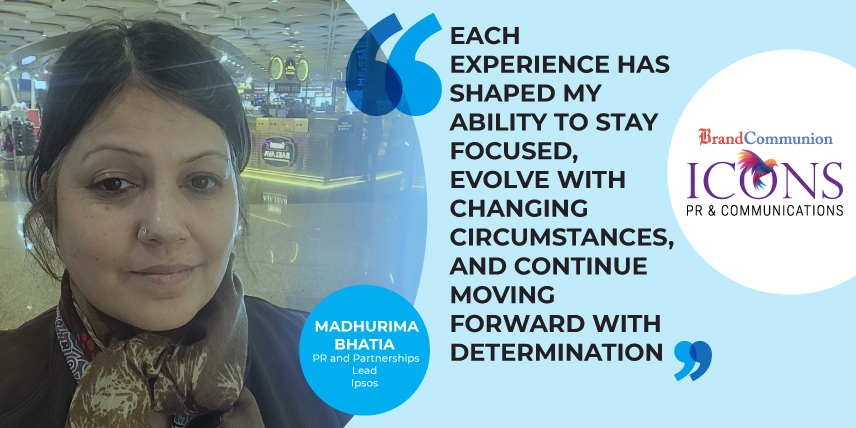


For Madhurima Bhatia, PR has been a journey shaped by curiosity, adaptability and a deep understanding of the power of strategic storytelling. Her entry into the profession was unexpected when a headhunter introduced her to a role at the perception management firm India InfoMedia. What began as an unfamiliar career path soon evolved into a diverse professional journey spanning media relations, corporate communications, market research and reputation management.
In the latest episode of Brand Communion’s ICONS series, Madhurima Bhatia, PR and Partnerships Lead at Ipsos, reflects on her unconventional entry into PR, the experiences and turning points that shaped her career, and the transformation of the communications industry over the years. She also shares her perspective on the future of PR, where AI is set to reshape execution while human judgement, credibility, strategic counsel and the ability to influence perception become increasingly important.
Edited Excerpts:
Q: How did your journey in PR begin? Was it a conscious career choice or something you attribute to chance? Did your parents understand and support your decision at the time?
I ventured into Public Relations when a head-hunter sent me for an interview at a perception management company, India InfoMedia. I had just moved out of the hospitality industry, where the role came with many perks, and had completed a short stint with a securities and surveillance company, Caddx Controls. I didn’t realize then how specialized this field is. The difference in how you write before PR training and after is striking.
I felt like a rookie, learning the ropes, managing large accounts, and understanding how to engage with the media. In those days, working with journalists was so straightforward: you faxed a press release or personally delivered it to media offices, and they would simply say, “OK, we’ll carry it.” And it would be splashed the very next day. Halcyon days. ????
Being an army brat, my parents only wanted me to excel and make them proud. The civil life was quite new to me from the protective cantonments.
Q: What would you consider your defining moment or breakthrough in the industry?
I’ll share two anecdotes.
First, when Mr. Harsimron Sandhu, the founder of India InfoMedia, sent me on a critical project to Goa for a Shaw Wallace assignment, the Director Special 1 millionth bottle for export. The Chief Minister, Mr. Pratap Singh Rane, was the chief guest. My writing was still quite rudimentary at the time, so Mr. Sandhu drafted the press release and faxed it to me. I got it printed on letterhead and arranged for a photographer to capture those landmark moments.
I had already established contact with key Goan media. Some attended the press conference, and for the rest, I distributed the press release along with photographs of the Chief Minister holding the Director Special bottle. The next morning, the news was splashed across all newspapers in Goa, including mainline, business, and regional publications. This project earned me a lot of plaudits, especially considering I was still a newcomer with no prior media contacts in Goa. I had relied on the INS (Indian Newspaper Society) directory to identify key media and had called each office ahead of the event. Everyone was incredibly polite and receptive.
Second, when I joined NFO MBL, a joint venture between NFO WorldGroup and MBL RCG, I again had zero visibility into market research. The induction across teams such as quantitative, qualitative, field operations, and data processing was an excellent learning curve. I learned how to read data and amplify share of voice through strategic storytelling.
Business Today gave us significant opportunities through co-branded editorial cover stories, and I had the privilege of working with a dream team including Sanjoy Narayan, Sukumar Ranganathan, and R. Sridharan. I also worked extensively with the editorial teams at The Times of India and CNBC TV18, working with Senthil Chengalvarayan, Shereen Bhan, and B. Sai Kumar, who was CEO at the time.
During this time, I was honored with two key performance awards, Employee of the Quarter and Employee of the Year.
Q: Can you tell us about the toughest phase in your career and what that period taught you?
Growing up with an army officer father taught me to turn challenges into opportunities. I have carried that mindset through every phase of my career, navigating change with resilience and purpose. During the merger of Synovate with Ipsos, I embraced a significant shift in responsibilities, moving from leading marcomms to driving business growth, and delivered in that role for several years.
Earlier, when I returned to work after motherhood, I adapted quickly to new demands while balancing multiple priorities, strengthening both my professional and personal capabilities. Each experience has shaped my ability to stay focused, evolve with changing circumstances, and continue moving forward with determination.
Q: How have you seen PR evolve from when you started to today’s digital-first world? What are some key changes that stand out to you?
Earlier, the media were defined by print, television, and radio. News in print appeared the next day, television focused on breaking updates, and radio ensured wide reach across regions, including the hinterlands. Today, digital has overtaken both TV and print in advertising, and it has become the fastest channel for earned news as well. With widespread internet access and deep smartphone penetration, information is now available instantly at the tap of a screen.
This digital-first shift has fundamentally transformed the PR industry. The pace of news has accelerated, audiences are always on, and engagement is immediate and measurable. PR today is no longer just about managing narratives but about responding in real time, leveraging data, and creating integrated strategies that work seamlessly across platforms. The result is a more dynamic, responsive, and impact-driven communications landscape.
Q: What is one piece of advice you would give to someone just entering the PR industry? And if given the chance, would you still choose a career in PR today?
Don’t just look at mass communication. Look at a management degree. It is not just PR, but corporate communications that cover corporate news, marketing narratives, CSR, and strategic storytelling. Start at the grassroots with a PR agency that gives you the nuts and bolts of training across a labyrinth of sectors and strategic planning.
I am glad I was trained in this role, and of course, 90 per cent of the learning happens on your own. You realize you are that one person who has to strategize. I have largely worked without teams, so I have been both the junior and the senior at the same time.
Q: What is one common misconception about PR that you would like to correct?
In the past, the term was loosely used in government offices, where they would say “yeh PR dekhte hain,” and it almost made me frown; further, it was often seen as a non-serious, cost-to-company function. Today, that perception has evolved. We are the extended arms of journalists and strategic advisors to India Inc and companies.
We build reputation and shape perception. We help shift stakeholder mindsets so that companies are recalled and perceived for their true expertise, in a way that clearly defines them and resonates.
Q: Where do you see the PR industry heading in the next five years?
Over the next five years, the PR industry will evolve from traditional media relations into a more strategic reputation and influence function, where AI handles much of the execution and human value shifts to judgment, narrative shaping, and senior counsel. Communication will become faster, more real-time, and increasingly predictive, with PR sitting closer to business strategy across corporate, marketing, and leadership advisory roles.
Earned media will continue to hold centre stage due to its credibility and its growing relevance in Generative Engine Optimisation, becoming critical to how brands surface and are interpreted in AI-driven discovery and reputation building. In this landscape, leaner teams will manage larger mandates, making experience, instinct, and the consistent ability to shape perception the key differentiators of the profession.
Q: If your PR journey had a headline, what would it be?
An unseen architect of narratives, consistently driving reputation, credibility, and business outcomes.
It is only recently that reputation management specialists have started emerging from the woodwork.