

There was a time when public relations in India was largely associated with press releases, phone calls to journalists and the ability to get a company or executive into the news.
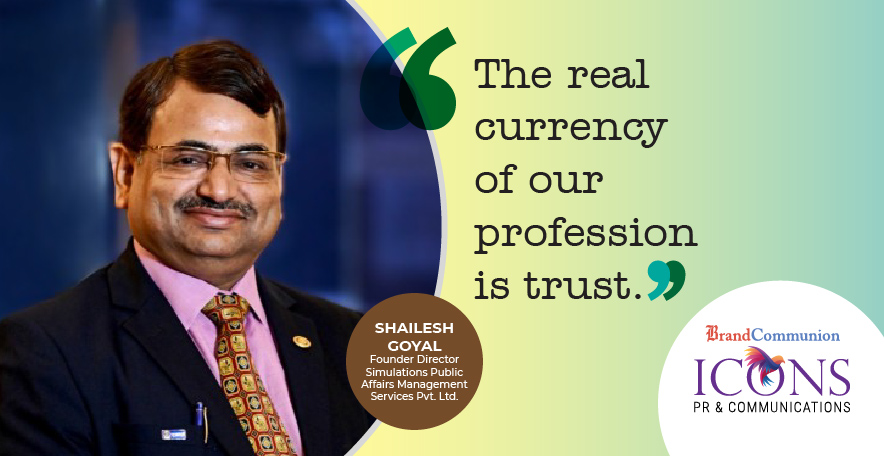
Shailesh Goyal entered the profession at a time when PR was still finding its place in the corporate ecosystem. Three decades later, he has watched the discipline transform into a strategic function shaped by reputation, data, technology and stakeholder expectations.
For Goyal, however, one thing has remained constant: the power of a good story and the importance of trust behind it.
The Founder Director of Simulations Public Affairs Management Services Pvt. Ltd., Goyal describes his journey as one that began with a love for stories and evolved into a career in strategic reputation management. Before moving fully into PR, he spent close to a decade with organisations including Bennett, Coleman & Co. (The Times of India Group), Living Media (The India Today Group) and Torrent Pharmaceuticals.
Those experiences, he says, became his “real classroom”, teaching him that while communication may be an art, reputation management requires discipline and a long-term approach.
In the latest edition of our PR Icon series, Shailesh Goyal, Founder Director, Simulations Public Affairs Management Services Pvt. Ltd., reflects on his journey of more than three decades in public relations from making a conscious shift from media and corporate roles to building a reputation management firm at a time when PR was still an emerging discipline in India.
From media to reputation management
Goyal’s decision to move into PR was deliberate. In the late 1990s, when he eventually set out to build Simulations, public relations was still a relatively nascent and often misunderstood profession in India.
For his family, the move was understandably difficult to comprehend. Leaving an established media career to build a business around something as intangible as reputation appeared risky. But as the work began translating into credibility for clients, that scepticism gradually gave way to support.
Looking back, Goyal sees the move as a natural extension of his interests rather than a gamble.
His defining breakthrough, however, did not come in the form of a particular award or campaign. It came when the nature of the conversations around him changed.
“There came a point when I stopped being called just to ‘fix a story’ (or ‘get us a story’) and started being invited to ‘fix the strategy’,” he recalls.
For Goyal, that transition from being viewed as a communications vendor to being trusted as a strategic partner was the real turning point.
It also coincided with a growing recognition that specialist reputation management firms could bring a more nuanced and long-term approach to corporate communications. When a major FMCG client publicly attributed improvements in trust and business performance to a communications and stakeholder strategy, Goyal saw it as validation of the model he had been building.
Simulations, in his view, had moved from the periphery of the business conversation to the centre of it.
Learning resilience the hard way
Every long career has its difficult chapters. For Goyal, the toughest period came in the early years of Simulations.
The consultancy was established in Gujarat at a time when the region experienced significant upheaval. The devastating earthquake of 2001 came during the firm's first year, followed by communal unrest the following year.
For a young independent consultancy, survival during that period was less about chasing growth targets and more about remaining relevant and resilient.
But those experiences also shaped Goyal's philosophy of PR.
“Credibility is truly earned in adversity,” he says.
The experience taught him that clients remember who stands with them after the cameras leave and the headlines disappear. It also reinforced his belief that the most valuable asset for a PR consultant is not simply a contact book, but the ability to offer calm, clear and ethical counsel when an organisation is facing a crisis.
For Goyal, relationships forged during difficult periods can become the foundation for years of trust.
From fax machines to an always-on reputation economy
The PR industry that Goyal entered bears little resemblance to the one operating today.
The fax machine and press release have given way to social listening, digital storytelling, real-time conversations, data analytics and artificial intelligence. Communication is no longer confined to the media; organisations are constantly being evaluated by consumers, employees, investors, regulators and other stakeholders across multiple platforms.
Goyal has witnessed this transformation from close quarters.
“When I started, PR was largely a world of press releases, fax machines, follow-up calls and personal visits,” he says.
Today, he believes PR is less about simply disseminating news and more about systematically building and protecting reputation across earned, owned and paid channels.
The biggest changes, according to him, have been speed, transparency and data.
Technology has made it possible to track conversations in real time, understand sentiment and measure outcomes with greater precision. AI is now being used across content development, targeting and analysis, raising expectations from both agencies and clients.
Yet Goyal does not see technology as replacing the fundamentals of the profession.
“The heart of PR remains the same: understanding people, building trust and sustaining human connections,” he says.
Beyond the idea of ‘spin’
One of Goyal’s strongest views concerns a misconception that has followed the PR industry for decades that public relations is primarily about spin or image management.
He disagrees.
“If your product is flawed or your ethics are compromised, no PR strategy in the world can sustainably fix that,” he says.
For him, effective PR is about transparency, alignment and accountability. The role of a communications professional is not to conceal an organisation's weaknesses, but to help ensure that its internal reality matches its external promise.
His analogy is particularly telling: “We are not here to paint a masterpiece over a cracked wall; we are here to help the client build a wall that does not crack in the first place.”
That philosophy reflects a broader shift in how Goyal views the profession from communication as a tactical function to reputation as a business asset.
Preparing for an AI-led future
Goyal believes the next phase of PR will be defined by a combination of technology and human judgement.
AI will increasingly support content creation, stakeholder intelligence, targeting and analytics, while data will give communications teams greater visibility into what audiences care about and how communication affects business outcomes.
At the same time, he expects issues around corporate ethics, sustainability and social responsibility to become increasingly important in determining which brands build lasting reputations.
At Simulations, Goyal says the organisation is already exploring AI-enabled content development and smarter targeting while continuing to invest in digital capabilities.
But he remains clear about where technology stops.
Technology can process information and accelerate execution. Strategic counsel, judgement and human sensitivity, in his view, remain central to reputation management.
He believes the firms that will lead the next phase of the industry will be those that can combine strong storytelling with data literacy, technological capability and an uncompromising ethical foundation.
Relationships before tactics
After more than three decades in the profession, Goyal's advice to young PR professionals is remarkably straightforward: build relationships before focusing on tactics.
The tools, platforms and formats will continue to change. Trust, he believes, will not.
“Invest in listening, stay curious about people and businesses, and guard your integrity fiercely,” he says.
It is also why, despite having spent decades in the profession, Goyal says he would choose PR all over again.
The attraction lies in the combination of creativity, strategy, impact and responsibility and in the fact that every day brings a new story, a new challenge and a new reputation to understand or protect.
A journey summed up in one line
If Goyal had to put a headline to his career, he would call it: “From Storyteller to Strategist: Building Trust, One Relationship at a Time.”
It is a fitting description of a journey that began with an interest in stories, moved through journalism and corporate experience, and eventually evolved into a career dedicated to helping organisations navigate the increasingly complex world of reputation.
But for Goyal, the story is not only about the evolution of PR or the growth of Simulations. It is also about the people who have shaped the journey: mentors, clients, colleagues and partners who entrusted him with what he considers an organisation's most important intangible asset: its reputation.
And perhaps that is the thread that connects the fax-machine era of PR to today's AI-powered communications landscape.
The tools have changed. The platforms have changed. The speed has changed. The value of trust has not.