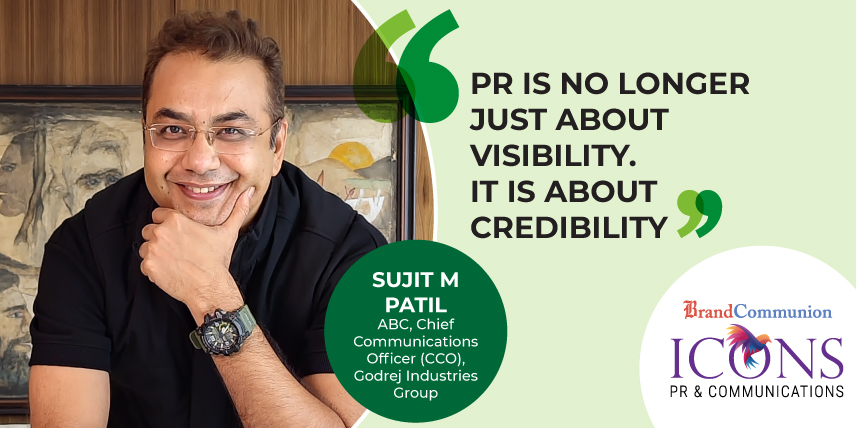


For Sujit M Patil, ABC, Chief Communications Officer (CCO), Godrej Industries Group, a career in public relations was never part of the original blueprint.
An instrumentation engineer by training, Patil entered the world of communications through a series of what he describes as “beautifully unpredictable” detours from sales engineering and an MBA to marketing communications at Emerson.
What began as serendipity eventually became a deliberate career choice, taking him through leadership roles and landmark communication mandates, including the global rebranding of Tata Chemicals across four continents and the building of a pioneering in-house communications function at Godrej.
In this Brand Communion Icon Series, Sujit M Patil shares his journey in the industry, challenges, defining moment and many more.
Edited Excerpts:
Q: How did your journey in PR begin? Was it a conscious career choice or something you attribute to chance? Did your parents understand and support your decision at the time?
My journey into PR was not a straight highway; it was more like a beautifully unpredictable Mumbai monsoon detour. I began as an instrumentation engineer because at that time, career choices in many Indian homes were refreshingly simple: engineering or medicine.
My father was a scientist at Bhabha Atomic Research Centre (BARC), and my mother was a school principal, so there was enough intellectual pressure at home to power a small nuclear reactor but sadly no understanding of “Public Relations” as a profession.
But while engineering gave me discipline and analytical rigour, my heart was drawn to people, persuasion, brands, and behaviour. My job as a sales engineer opened that door.
Later, after an MBA and a job rotation into marketing communications at Emerson, I discovered that communications allowed me to combine my technical grounding, sales experience, creativity, and curiosity.
So yes, it was partly serendipity. But what begins as chance must eventually become choice. PR and communications became that choice for me. And I loved it.
My parents may not have fully understood the world of communications at first, but they understood sincerity, hard work, and growth. Once they saw that this profession was not about “talking” but about building trust, shaping reputations, and creating meaningful impact, their support was complete.
Q: What would you consider your defining moment or breakthrough in the industry?
There have been many milestones, but one defining phase was my time at Tata Chemicals, where I had the privilege of leading the global rebranding of the company across four continents.
That experience taught me that communications is not a cosmetic function; it is a strategic force that can align people, businesses, cultures, and markets around a shared purpose.
Another breakthrough came at Godrej, where we built one of the country’s most respected in-house communications functions. Launching owned media properties, built India’s first in-house digital PR practice, created research-driven narratives, and shaped reputation at a group level.
The real breakthrough was this: seeing communications move from the margins to the centre of business strategy. That is when you know the profession has grown up.
Q: Can you tell us about the toughest phase in your career, and what that period taught you?
One of the toughest phases came around 2013, when I reached a personal and professional crossroads. I had achieved many things, but I began asking myself a more uncomfortable question: what do I truly want to be known for?
It was one of those “midlife crisis meets PowerPoint deck” moments. I wanted to make a larger impact, not just move from one designation to another.
Around that time, I also bought some farmland in Karjat. No Wi-Fi, no distractions, just soil, silence, and a generous reminder that I was not exactly born a professional farmer.
But that phase taught me something profound. Growth needs pauses. Strategy needs stillness. And sometimes, getting your hands dirty in actual mud helps you understand leadership better than any management book.
Professionally, moving to Godrej that year became a dream opportunity. It gave me the canvas to build, experiment, and shape reputation at scale. The lesson was simple: tough phases are not always breakdowns. Sometimes they are invitations to reimagine your next chapter.
Q: How have you seen PR evolve from when you started to today’s digital-first world? What are some key changes that stand out to you?
When I started, PR was often seen through the lens of media relations. Today, it is about trust-crafting. The shift has been extraordinary.
Earlier, communication moved through defined channels and gatekeepers. Today, every stakeholder is a publisher, every employee can be an ambassador, every consumer can be a critic, and every moment can become a narrative. The old world rewarded access. The new world rewards authenticity, agility, and accountability.
At Godrej, we responded to this shift by building an in-house digital PR practice, launching owned media platforms, and creating a vertical for research-led narratives. That was important because the future of communications cannot depend only on borrowed attention. Brands must create their own voice, their own evidence, and their own communities.
The biggest change is that PR is no longer just about visibility. It is about credibility. In a digital-first world, people do not simply ask, “What is the brand saying?” They ask, “Is the brand living it?”
Q: What is one piece of advice you would give to someone just entering the PR industry? And if given the chance, would you still choose a career in PR today?
My advice is: stay curious, stay useful, and stay human.
PR is not a profession for people who only love words. It is for people who love worlds. You must understand business, culture, technology, policy, communities, media, data, and above all, people. Read widely. Listen deeply. Build relationships before you need them. And never confuse noise with influence.
Also, do not chase headlines before you build credibility. A headline may last a day, but reputation compounds over years.
And yes, I would absolutely choose PR again. In fact, I would choose it with even more enthusiasm today. There has never been a more exciting time to be in communications. We are no longer just message managers. We are reputation builders, sense-makers, culture translators, and sometimes, the calmest people in the room when everyone else has discovered “urgent” on email.
Q: What is one common misconception about PR that you would like to correct?
The biggest misconception is that PR is publicity. That is like saying farming is only about taking a photograph with a vegetable basket.
PR is far deeper. It is about trust, reputation, relationships, stakeholder intelligence, organisational behaviour, and long-term credibility. Good PR does not manufacture reality. It makes meaningful reality visible.
The best communications professionals are not spin doctors. They are sense-makers. They help organisations listen better, act better, and communicate better. Publicity may get you attention. Reputation earns you permission to be believed.
Q: Where do you see the PR industry heading in the next five years?
The next five years will belong to communicators who can combine data with judgement, technology with empathy, and speed with wisdom.
AI will transform content creation, monitoring, analytics, and stakeholder mapping. But the real differentiator will remain human judgement. Machines can help us process signals. Humans must still interpret meaning.
PR will become even more integrated with business strategy, ESG, employer brand, public affairs, crisis preparedness, digital influence, and leadership reputation. The CCO of the future will need to be part storyteller, part strategist, part sociologist, part technologist, and part conscience keeper.
The future will not be about controlling the narrative. It will be about earning trust in a world where narratives are co-created every minute.
Q: If your PR journey had a headline, what would it be?
“From Instrumentation to Inspiration: A Serendipitous Journey of growing Trust, Brands, and seasonal vegetables in Karjat.”