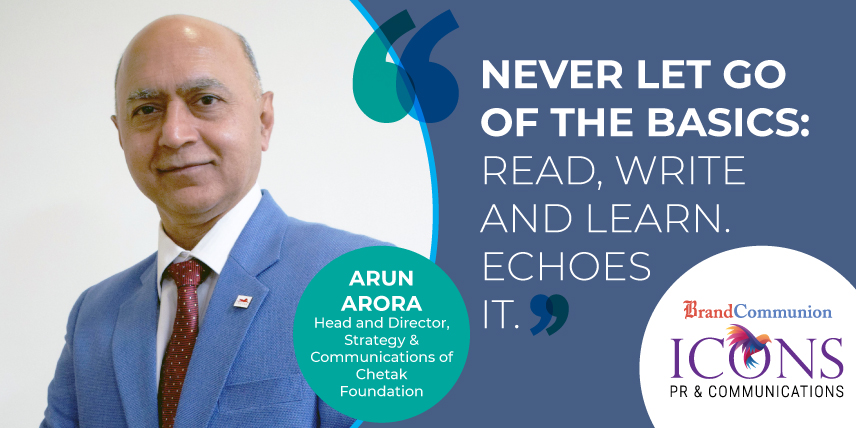


For Arun Arora, a career in corporate communications was never mapped out from the beginning. What started in the early 1980s as a fortunate twist of fate evolved into a more than 35-year journey across some of India’s leading corporate organisations, including Escorts, Maruti Suzuki, GMR Delhi Airport, Jindal Steel & Power, GVK, Cairn Oil & Gas, and Vedanta.
In this edition of the Brand Communion ICON series, Arun Arora, Head and Director, Strategy & Communications, Chetak Foundation, reflects on the defining moments and toughest phases of his career, the evolution of corporate communications, and the lessons that have shaped his journey over more than three decades.
Edited Excerpts:
Q: How did your journey in PR and Communication begin? Was it a conscious career choice or something you attribute to chance? Did your parents understand and support your decision at the time? What would you consider your defining moment or breakthrough in the industry?
My journey in Corporate Communications and PR began in the early 1980s, not by grand design but through a fortunate twist of fate. Armed with a passion for writing, storytelling, and public affairs, I stepped into a field that was still finding its feet in India’s corporate world. What started as an uncertain foray soon blossomed into a deeply fulfilling calling that has spanned over 35 years.
I had the privilege of steering Corporate Communications for some of India’s most iconic organisations like Escorts, Maruti Suzuki, GMR Delhi Airport, Jindal Steel & Power Ltd., GVK, Cairn Oil & Gas, Vedanta, and later contributing to the Chetak Group and Haritash Maison ecosystem. It was far from a conventional career path in those days. Like many parents of that era, mine were initially worried about its stability compared to traditional professions. But as they saw the impact I was creating and the recognition that followed, they became my strongest pillars of support.
The defining moments arrived in waves. From managing high-stakes reputation challenges at Maruti Suzuki and GMR, to navigating complex infrastructure and energy sector narratives, and then taking the entrepreneurial leap by founding “Click Biz Solutions” after Vedanta. Equally transformative has been my work with development champions like Be Artsy, Chetak Foundation, and India CSR, and my shift into academia, teaching Effective Communication, Soft Skill Development, CSR, and Sustainability. These chapters expanded my world from corporate storytelling to creating broader societal impact and mentoring the next generation. The recognitions bestowed by credible organisations along the way have been deeply humbling.
Q: Can you tell us about the toughest phase in your career, and what that period taught you?
The most demanding chapters of my career unfolded while handling communications for large-scale infrastructure and energy projects at GMR, GVK, and Cairn Oil & Gas. In the eye of intense public, regulatory, and media scrutiny, I had to balance the expectations of governments, local communities, investors, and journalists, often all at once. It was a true test of strategy, endurance, and emotional intelligence.
Later, stepping away from the security of large corporates to build “Click Biz Solutions” and work with development organisations brought a fresh set of entrepreneurial struggles. These challenging seasons taught me that resilience, empathy-driven engagement, ethical transparency, and agility are non-negotiable. Above all, they reinforced a powerful truth that real reputation is not manufactured; it is earned through consistent actions, trust, and purpose-driven communication. These lessons continue to shape my teaching in CSR and Sustainability, as well as my writing, including the biography “JKS: The Logistics Man of India” (A rags to riches story of Shri Jai Karan Sharma, Founder Chetak Logistics, a farmer’s son from a small village, Jhinjhar, Haryana, and a school dropout, who with his hard work, vision, passion and perseverance went on to set up one of the largest logistics companies in India).
Q: How have you seen PR evolve from when you started to today’s digital-first world? What are some key changes that stand out to you?
When I entered the industry, Corporate Communications revolved around traditional media relations — crafting press releases, nurturing journalist relationships, and waiting for the morning papers. It was a slower, more linear world. I still recall that I would remember the landline phone numbers and even the fax numbers of major publications in India.
Today, it has transformed into a vibrant, always-on, digital-first ecosystem. The biggest shifts I’ve witnessed are the move to real-time, two-way conversations, the explosive rise of social media and influencers, the power of data-driven insights, and the seamless blending of PR with ESG, sustainability, and digital platforms.
My work in sustainability communications with India CSR, Chetak Foundation, and academia has revealed how communication today goes far beyond business narratives — it has become a powerful force for driving genuine societal value and responsible growth. The demand for authenticity in a noisy world has never been greater.
Q: What is one piece of advice you would give to someone just entering the PR industry? And if given the chance, would you still choose a career in PR today?
Oh, how I love giving advice! My foremost advice to anyone stepping into this field is, “Master the art of authentic storytelling, invest deeply in stakeholder relationships, and always align your communication with purpose, ethics, and real impact. Stay endlessly curious about technology, sustainability, and shifting societal currents. Cultivate the habit of listening intently, understanding business deeply, and having the courage to speak truth to power. While technical skills may open doors, it is judgment, integrity, and adaptability that will sustain a long and meaningful career.”
Never let go of basics, “Read, Write and Learn…..”
Interestingly, I have also learnt never to give advice, unless asked for!
And yes, without a moment’s hesitation, I would choose this path again. First, in today’s complex and fast-changing world, the power of strategic communication to build trust, enable responsible growth, and create shared value feels more relevant and exciting than ever before. And second, the PR and Communication have become a strategic function, which is increasingly finding a place on the Board.
Q: What is one common misconception about PR that you would like to correct?
Many people still perceive PR as mere “publicity” or clever spin, issuing press releases and chasing media coverage. In reality, strategic Corporate Communications is far more profound. It is about reputation stewardship, trust-building, ethical advisory, and creating lasting value. It includes crisis leadership, thoughtful stakeholder alignment, sustainability communication, and ensuring organisational actions genuinely reflect societal expectations. My diverse journey across corporates, start-ups, sustainability platforms, and academia has only deepened this conviction.
I wish we all in the PR and Communication professions would lay greater focus on improving the image of our own profession.
Q: Where do you see the PR industry heading in the next five years?
Looking ahead, I see the PR industry evolving into a more integrated, technology-enabled, and deeply purpose-centric profession.
We will witness AI playing a bigger role in research, personalisation, and analytics, freeing communicators to focus on strategy, creativity, and human empathy. There will be a stronger emphasis on measurable outcomes linked to business results, ESG performance, and reputation metrics. Authentic, leader-driven storytelling and powerful sustainability narratives will gain even more prominence. Above all, ethical communication and societal impact will become non-negotiable in an increasingly polarised digital world.
The leaders of tomorrow will be those who bring rich, cross-sector experience, blending corporate insight with entrepreneurship, sustainability, and academic perspectives.
Q: If your PR journey had a headline, what would it be?
“Building Trust Across Worlds - From Corporate Frontiers to Sustainability, Entrepreneurship & Academia.”
And that “I continue to learn……”