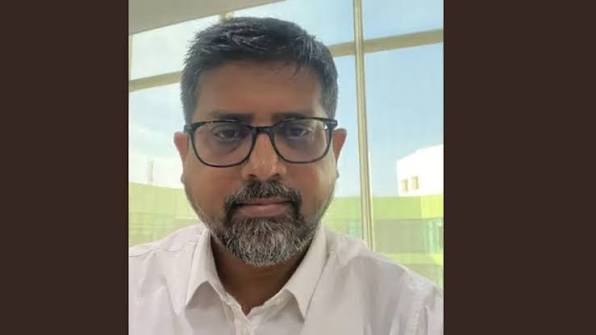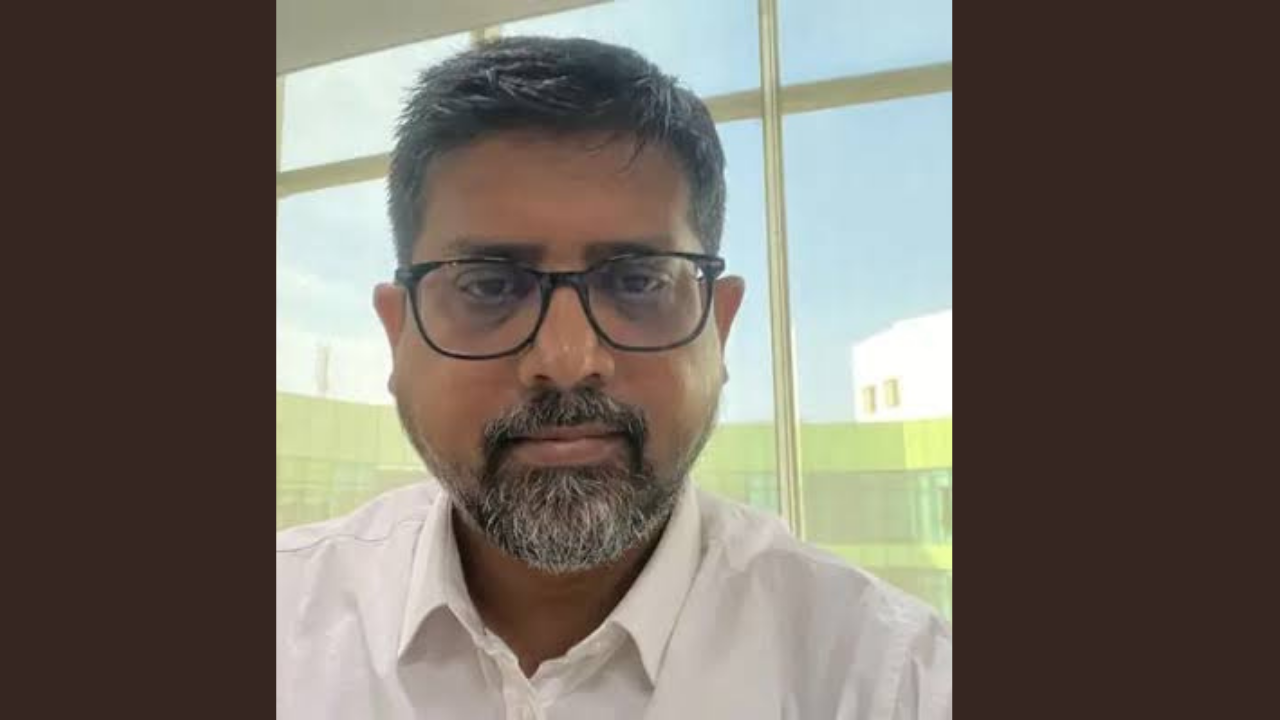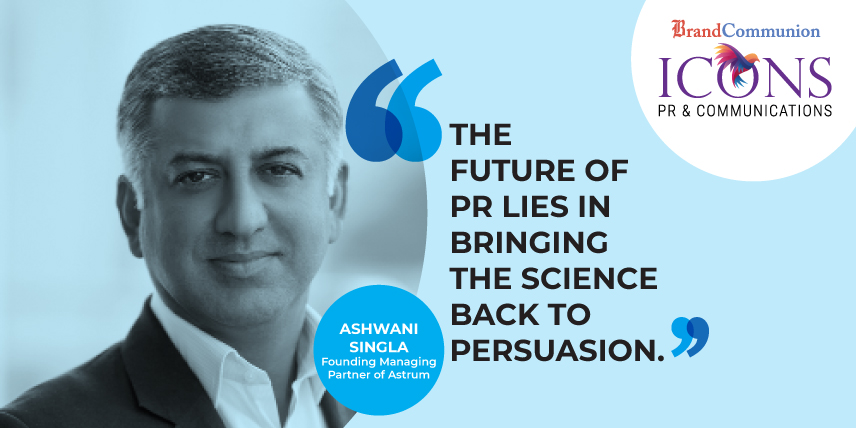


For Ashwani Singla, Founding Managing Partner of Astrum, a career in public relations began almost by accident. A chance interaction with Neeran Chibber, then CEO of Mudra PR, in 1995 set him on a path that would take him from hospitality and management education to building a career around strategic communications, research and the science of persuasion.
Over the years, Singla has witnessed PR evolve from a profession largely driven by media relationships to one shaped by data, digital platforms, creators, communities and increasingly, artificial intelligence. Yet, he believes the fundamental purpose of the profession remains unchanged: earning trust and respect.
In this Brand Communion PR ICON series Singla reflects on his journey, his work in building Genesis PR, the founding of Astrum, the role of research and behavioural science in communications, and why the future of PR will depend on combining technology with human judgement.
Edited Excerpts:
Q: How did your journey in PR begin? Was it a conscious career choice or something you attribute to chance? Did your parents understand and support your decision at the time?
My entry into public relations was accidental, but staying in it was a conscious choice. I began my career in hospitality with ITC in the 1988 and took a break in 1994 to upskill myself and obtained a PG diploma in Management from IMI, New Delhi.
In 1995, a chance interaction with Neeran Chibber, then CEO of Mudra PR, steered my career to public relations. My early research into the profession unearthed a dire need to move the profession from predominantly ‘know who’ driven to being anchored in ‘know how’. Being an economics graduate, I was attracted to public relation’s intersection of economy, business, and society and its central role in earning trust and respect of public or what is popularly known as goodwill.
Since this was a mid-career pivot and I was married by that time, so more than my parents, it is Sheila, my wife and best friend, whose wholehearted support for my choice propelled me forward.
Q: What would you consider your defining moment or breakthrough in the industry?
One defining phase was my work was for the BJP as a campaign strategist, during the historic 2014 Lok Sabha elections. It reinforced my belief that persuasion is not instinct alone, it is deeply rooted in a dep stakeholder understanding driven by the trifecta of data science, social science and neuroscience. My team and I conducted India’s largest ever polling exercise covering over 350 parliamentary constituencies to develop the insights that informed the historic victory.
However, my contribution in shaping the success of Genesis PR from 1998 to 2010 to a premier and an aspirational consulting firm with the ALP programme at the heart of its talent development strategy probably was the most satisfying.
The passion project of my life however, is Astrum (www.astrum.in), India’s first research-based strategic communications consulting firm built around what we call the Science of Persuasion. The idea was simple: communication becomes far more persuasive when it is informed by insight, human understanding and rooted in evidence; when complimented with multi-stakeholder advocacy, it delivers strategic influence.
Q: What was the toughest phase in your career, and what did it teach you?
Entrepreneurship tests your conviction every day as you make the choices that will come to define you.
Astrum is founded on a simple belief that effective advocacy is driven by Science. An idea whose time had come but yet to be adopted!
Therefore, the choice to make is to do the work that means most to you but also to walk away from the work that is ‘more of the same’ but could help pay the bills.
It’s the choice to stay true to your convictions that is tested every day and every month, when the salary pay day comes J
As we celebrate the 11the anniversary of Astrum, I can look back and say with confidence that my conviction paid off.
How have you seen PR evolve from when you started to today's digital-first world? What are some key changes that stand out to you?
When I started, PR was heavily associated with media endorsements and that was clients hired you for good press or stopping bad press. Most clients would ask “who do you know in the media?”
Today, influence is fragmented across digital platforms, creators, communities and stakeholder ecosystems. Information moves in real time, and reputation can shift overnight.
Technology has transformed the profession significantly. Data analytics, digital intelligence, predictive monitoring and now AI are changing how organisations understand public sentiment and reputational risk.
But interestingly, despite all the technological evolution, the core principle of public relations unchanged: earning trust and respect.
In many ways, I believe the future of PR lies in rediscovering what some of the early practitioners of the profession always believed, that persuasion is rooted in psychology, sociology, research and human behaviour. Technology will strengthen this capability, not replace it.
Q: What is one piece of advice you would give to someone just entering the PR industry? And if given the chance, would you still choose a career in PR today?
Stay curious, stay adaptable and never stop learning.
The 21st century communicator will need to understand far more than media or messaging. They will need to understand business, policy, technology, behavioural science, geopolitics and increasingly, AI.
Technology will automate many tasks, but judgement, ethics, contextual understanding and strategic thinking will remain deeply human capabilities.
I strongly believe the industry must invest far more seriously in developing 21st century communications leaders who combine technology fluency with human insight.
And yes, I would absolutely choose this profession again. Few professions allow you the width and depth of learning to shape business and society at the scale communications does.
What is one common misconception about PR that you would like to correct?
That PR is only about media coverage.
Media relations is important, but strategic communications is much larger than that. It is about strategic influence: understanding and engaging diverse stakeholders, earning trust, anticipating & mitigating risks and helping organisations navigate increasingly complex policy landscape.
Another misconception is that communications is driven only by creativity or instinct. The best communication strategies are rooted in insight, research and evidence.
At Astrum, we often say that the most important question is not just “what to say” but first “what to do.” Conduct shapes communication far more than messaging alone.
Q: Where do you see the PR industry heading in the next five years?
The industry will become significantly more intelligence-led, technology-enabled and multidisciplinary.
AI will transform research, monitoring, content assistance and predictive analysis. Firms that do not adapt to technology will struggle. But equally, firms that depend only on technology without investing in human capability will also fall behind.
The future belongs to professionals who can combine data, behavioural insight, strategic thinking and ethical judgement.
C suite will increasingly expect communications to demonstrate business impact, stakeholder influence and reputation outcomes, not just vanity metrics.
Most importantly, authenticity will become the defining currency of trust.
Q: If your PR journey had a headline, what would it be?
“Bringing the Science Back to Persuasion.”