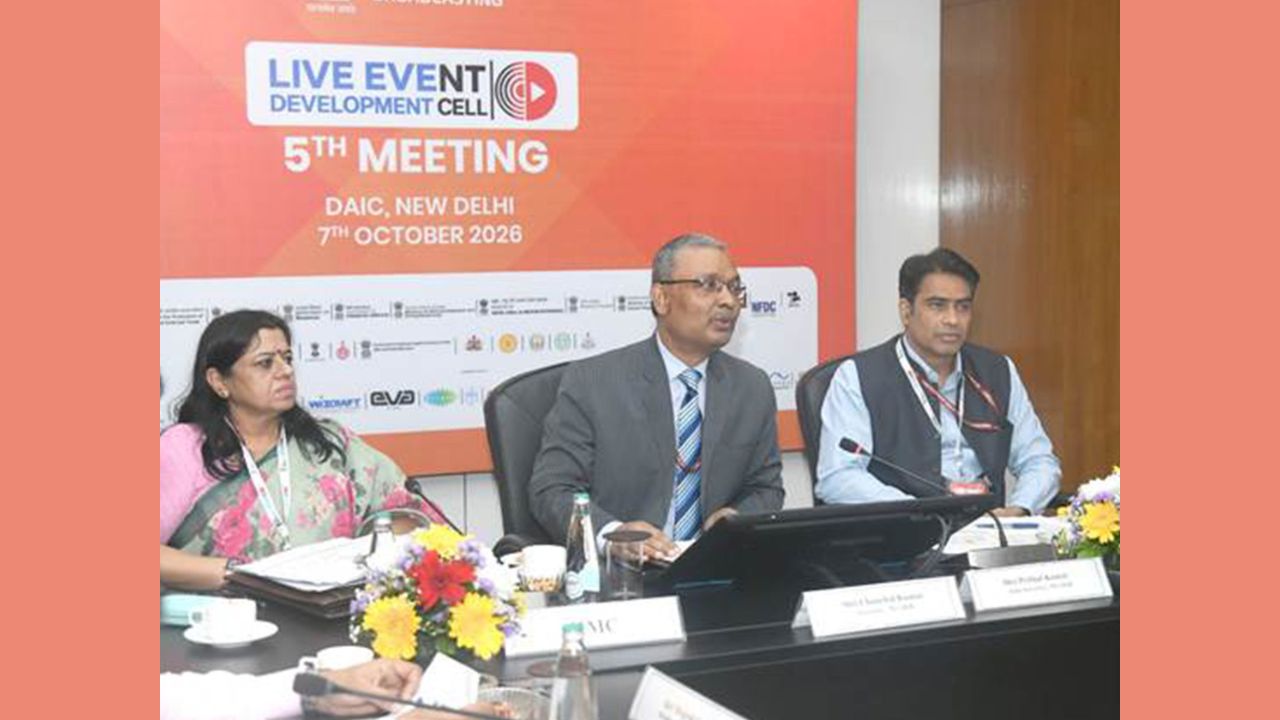


India’s live events sector has registered a 44% growth over the past year, with around 34,000 events held across the country, according to ANI, citing Chanchal Kumar, Secretary, Ministry of Information and Broadcasting. The sector currently supports more than one crore livelihoods, highlighting its growing contribution to India’s employment and entertainment ecosystem.
Speaking at the fifth meeting of the Live Events Development Cell (LEDC), Kumar said the government is targeting a doubling of the live events sector by 2030. The expansion is expected to generate an estimated 15–20 million direct and ancillary employment opportunities, further strengthening the industry's economic impact, ANI reported.
Kumar described the LEDC as an example of collaboration between the Centre, state governments and industry stakeholders. The cell currently brings together 14 Central Ministries and Departments, 10 States and Union Territories, and 21 industry bodies.
According to information shared at the meeting, the LEDC has been working on several measures to facilitate the growth of the sector, including a Model Executive Order, the Single Window Portal on India Cine Hub, streamlined approval mechanisms and skilling initiatives. The number of States and Union Territories that have appointed nodal officers has also increased from 16 to 29.
The meeting reviewed the implementation of the Single Window Clearances Portal for the live events industry through the India Cine Hub platform. States and UTs were encouraged to appoint nodal and authorised officers, integrate departmental and local licensing systems with the portal, transition the licensing process online, onboard live event venues and recognise event licensing as a time-bound public service.
Five states have so far adopted the Model Executive Order for Streamlining Licensing and Permissions for Live Events in India, 2026, which was circulated to States and UTs on March 13, 2026. Maharashtra has also adopted the framework and presented its implementation approach, while the remaining States and UTs have been urged to accelerate its adoption.
The government is also looking at measures to make India more accessible to international performers. The Ministry of Home Affairs has streamlined FRRO re-registration requirements for foreign performers undertaking short-term stays. Other measures under consideration include group visa provisions for artists and crews, customs duty exemptions for show equipment, integration of live entertainment skills into the National Skills Qualification Framework, and training, certification and apprenticeship programmes.
As part of its broader strategy, the government is looking to position India as a destination for event-led tourism. Discussions have also included financial and policy measures such as GST rationalisation, CSR alignment, infrastructure financing through Viability Gap Funding and blended finance, as well as bringing the live entertainment sector within the MSME framework, ANI reported.
The LEDC also discussed several proposed reforms, including the introduction of a single national music licence with notified tariffs to address overlapping licensing requirements from multiple rights societies. Other proposals include notified entertainment precincts under the Noise Pollution (Regulation and Control) Rules, 2000, and easing foreign remittance limits for payments to international artists.
Another key focus is the creation of pre-approved venues to reduce the regulatory burden on event organisers. The Archaeological Survey of India (ASI) and Sports Authority of India (SAI) have issued standard operating procedures for hosting live events at their properties, while major venues are proposed to be pre-approved so that organisers do not have to seek repeated venue-level permissions for individual events.
The LEDC also reviewed a proposed framework for brownfield and greenfield live-event venues. The framework envisages states identifying and developing dedicated venues, while qualifying live-event and performance infrastructure could be included in the Harmonised Master List of Infrastructure Sub-sectors. Project support through the Viability Gap Funding scheme is also being considered.
The meeting further discussed initiatives to strengthen the sector's talent pool. The Live Event Skilling Committee, chaired by the Vice Chancellor of the Indian Institute of Mass Communication (IIMC), presented an update on its proposed skilling curriculum. This includes an MoU between IIMC, the Media & Entertainment Skills Council (MESC) and the Event and Entertainment Management Association (EEMA), along with certificate and short-term programmes focused on live events.
The LEDC has also proposed the launch of Inclusivity Guidelines for Safety of Women and Divyang-jan at Live Events and Concerts and a Green Concert Protocol at WAVES 2027, in collaboration with industry stakeholders.
The Ministry of Information and Broadcasting, through the LEDC, is working with state governments and industry stakeholders to build a more streamlined regulatory, infrastructure and skilling ecosystem for India's expanding live events industry.