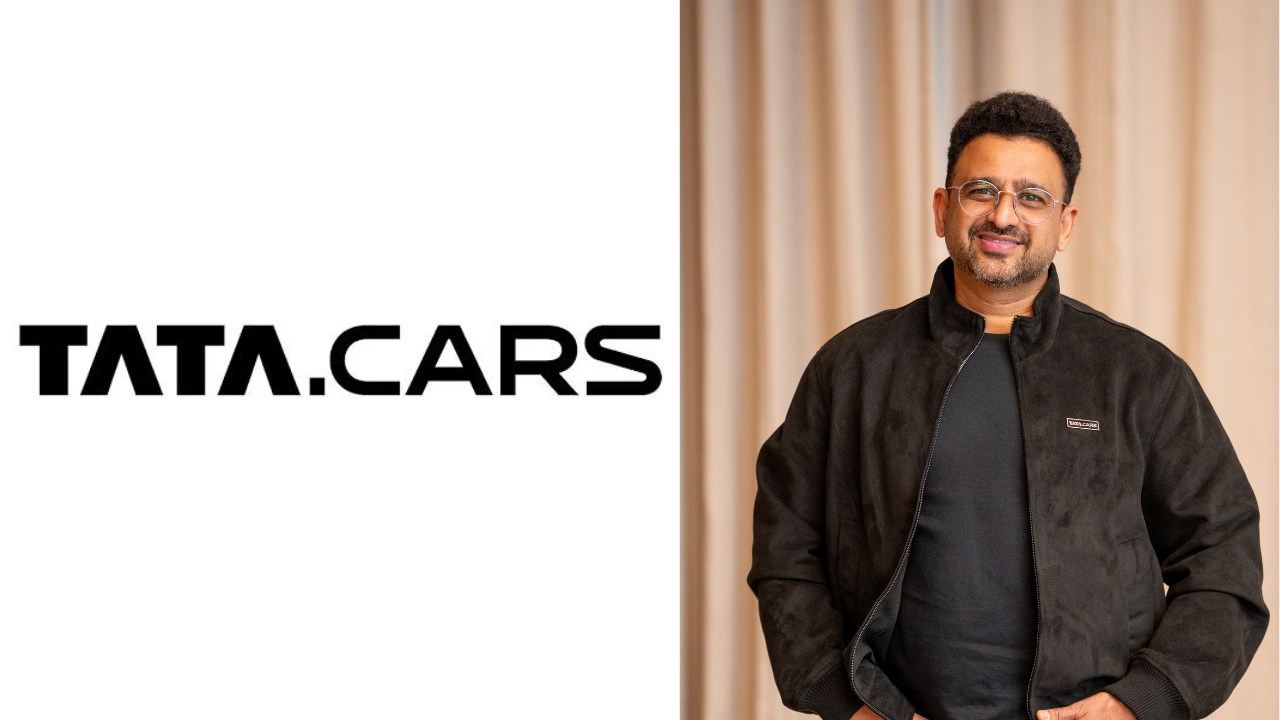


Tata Motors Passenger Vehicles is looking to reboot its brand for the next phase of growth, moving away from an industry-oriented identity towards a simpler, more consumer-centric proposition as it targets 20% market share and 30% EV penetration, according to Vivek Srivatsa, Chief Commercial Officer, Tata Passenger Electric Mobility.
The company is introducing TATA.CARS as its new customer-facing identity, bringing its passenger-vehicle portfolio under a single master brand.
The move comes after Tata Motors' demerger and the creation of an independent passenger-vehicle business, with Srivatsa saying the company now sees an opportunity to establish a distinct customer-facing identity.
“Since we are independent, it is good to get an independent customer-based identity,” Srivatsa said.
However, he stressed that the exercise is not a change to the legal corporate entity. Tata Motors Passenger Vehicles will continue to remain the company's legal name for statutory, regulatory and investor purposes, while TATA.CARS will become the consumer-facing identity across its website, digital channels, social media, retail and other touchpoints.
The transformation will extend beyond the name. The company is introducing a new brand design system, “Ambition Blue”, a new sonic identity and a visual system called “Parallel Pathways”, along with a new brand promise, “Nothing's Too Far.”
According to Srivatsa, the timing is also linked to the company's ambitions for the future.
“Tata Motors has openly announced our ambitions for the future. We want to move towards 20% market share and 30% EV penetration, among other things,” he said.
“While we have quite a few milestones in the past, it is also a good way for us to reboot to the future, and we would like customers to look at us as a company that is more future-oriented.”
From “Motors” to “Cars”
One of the more interesting aspects of the exercise is the decision to move from the industry-oriented “Motors” terminology to TATA.CARS.
Srivatsa believes the new identity reflects how consumers actually think about the category.
“Normally, an automotive category has too much jargon. We will move away from that consciously and make it more human-centric,” he said.
He pointed to the simplicity of TATA.CARS itself as an example.
“If you talk to an industry person, he will say a car is different, an SUV is different, a hatchback is different. But how do consumers speak? For consumers, a car is four-wheeled mobility. Simple. That is how it is expressed.”
The shift is also an attempt to address what Srivatsa sees as one of Tata Motors' existing brand challenges: the company is associated with several different attributes rather than one defining perception.
“Today we have a problem where Tata Motors Passenger Vehicles is known for many things. Number one is safety. If you go online or ask somebody, they'll say safe vehicles. Next, they'll say good-looking vehicles. Third, they'll talk about being relevant to India,” he said.
“It's a good thing to have multiple areas of perception, but I think one of the challenges is for us to narrow down into one big thing.”
A brand built around “Nothing's Too Far”
The new brand promise, “Nothing's Too Far,” is intended to go beyond physical mobility and tap into consumer aspirations.
Srivatsa said the proposition is rooted in Tata's history of taking on challenges that were previously considered difficult or impossible, from the Indica and Sierra to making EVs more accessible and pushing vehicle safety forward.
The company intends to use the promise not just in advertising but across its products, technology and customer experience.
“We are not looking at the brand name change or the promise change as a one-off campaign,” he said. “It is more a cultural change to challenge ourselves for the future, to continue our heritage but also reboot for the future.”
That distinction is important: Tata is not planning a conventional rebranding campaign around the launch.
Instead, every communication will progressively adopt the new colour, sonic signature and design system, while the company intends to extend the philosophy into its showroom and service experiences.
“The brand identity and brand promise change will take some time,” Srivatsa said, comparing the exercise with the decades it took to build trust in the Tata name.
No celebrity-led launch
Despite the timing ahead of the festive season, Tata does not intend to use a celebrity to launch the new identity.
“Our cars are our best brand ambassadors,” Srivatsa said, adding that celebrity usage by the company has historically been “very specific and time-bound.”
He also dismissed any direct link between the rebrand and the upcoming festive season, saying the timing is largely driven by the company's product-launch schedule.
Not about premium pricing
Tata Motors' new identity comes shortly after the company announced a price increase of up to Rs 25,000 across its passenger-vehicle portfolio.
But Srivatsa rejected a direct connection between the rebranding and an ambition to charge more.
“Premium is an experience. It doesn't always translate to cost,” he said.
According to him, the price increase is a short-term response to rising input costs, while the rebranding is intended to create a richer consumer experience.
“The rebranding will lead to a richer consumer experience, whether it is the way they see us in our communication, the way they see us in our showrooms or how our cars look. There is always an attempt towards a premium experience. Not to be confused with premium pricing.”
AI is about agility, not cutting costs
Srivatsa also offered an interesting view on how Tata Motors is approaching AI in marketing.
Rather than treating AI primarily as a cost-saving tool, the company sees it as a productivity and agility enabler.
“Today the challenge for marketers is agility more than cost saving,” he said. “If you are agile, you are on time. If you are perfect but late, the money is wasted.”
On AI-driven search and the rise of generative engines, Srivatsa said the company will need to adapt as consumer behaviour changes.
“We will have to first learn to optimise ourselves to be visible to GPT, and then we will see how it goes,” he said, adding that the company ultimately wants to be “where the consumer is.”
TATA.CARS will remain the umbrella for TATA.ev
While TATA.CARS will become the larger consumer-facing master brand, TATA.ev will continue to have an independent identity.
Srivatsa said the EV brand was created because EV consumers had a different approach to mobility and that distinction remains relevant.
However, TATA.ev will sit under the broader TATA.CARS architecture.
“TATA.CARS is the bigger umbrella company brand and TATA.ev will be a subset under it,” he said.
The larger bet
Perhaps the most revealing part of the conversation is that Tata Motors isn't presenting TATA.CARS as a new logo or campaign. It is positioning the change as a cultural reset.
The company wants its identity to reflect a passenger-vehicle business that is independent, future-oriented and less constrained by traditional automotive category definitions.
And Srivatsa's central argument is that Tata's next phase cannot simply rely on the equity it has already built.
“We have influenced how India moves, and Indian consumers move in the past, but we want to do more in the future,” he said.