

The way consumers discover brands is undergoing a fundamental shift. Search is no longer limited to scrolling through pages of blue links on Google. Increasingly, users are turning to AI platforms such as ChatGPT, Gemini and Perplexity for direct answers and trusting those responses.
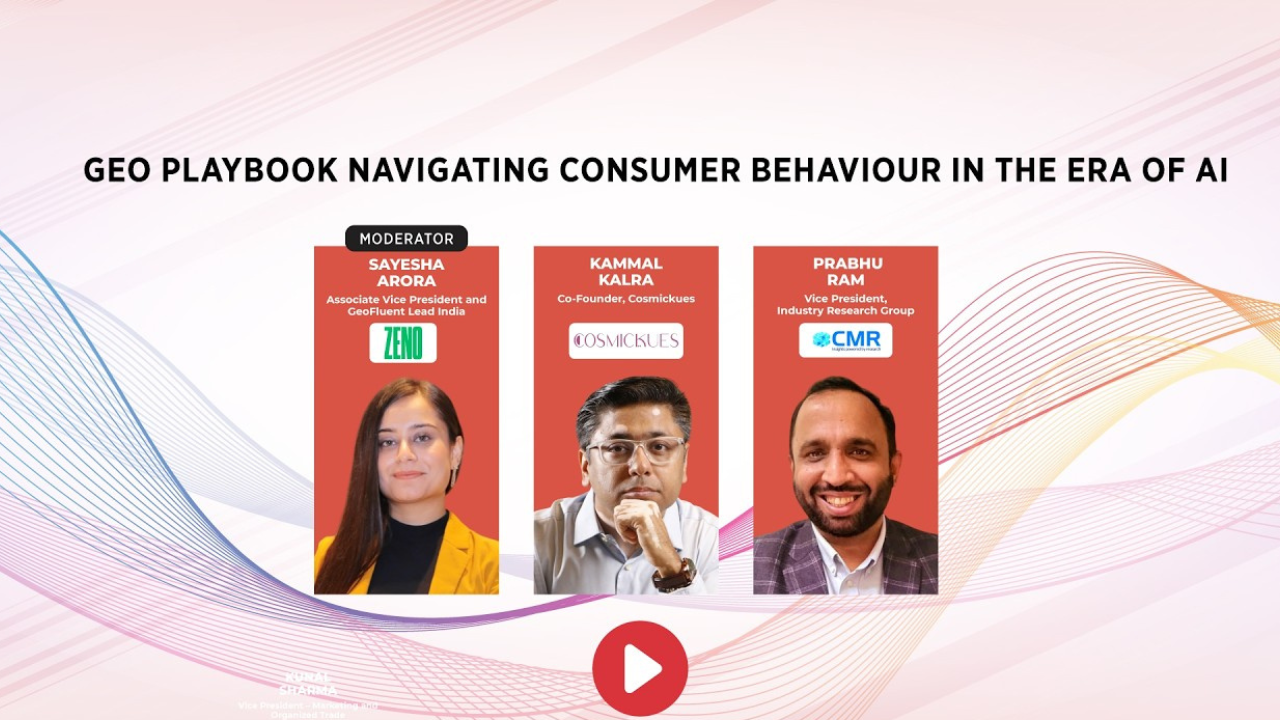
Brand Communion hosted its first flagship event, and hosted a panel discussion on 'GEO Playbook: Navigating Customers in the Era of AI', moderated by Sayesha Arora, Associate Vice President and GeoFluent Lead India at Zeno Group. The panelists are Prabhu Ram, Vice President, Industry Research Group at CyberMedia Research (CMR), and Kammal Kalra, Co-founder of Cosmickues.
Opening the discussion, Arora highlighted how AI has fundamentally altered the discovery journey.
"Two years ago, we would go to Google and browse through 10 or 20 links. Today, we are increasingly trusting AI-generated answers. That behavioural shift changes everything for communicators and marketers," she said.
According to Arora, while the final purchase decision still rests with humans, the point of discovery has shifted dramatically towards AI interfaces.
"It is still a human who decides which phone to buy or which form to fill. But discoverability has shifted. If brands are not present in AI-generated answers, they risk missing out on an entirely new layer of customer discovery."
She explained that this realisation led Zeno Group to launch Zeno GEO in late 2025, a solution focused on helping brands improve visibility across AI search platforms while also safeguarding their reputation.
"Today AI is embedded across Microsoft, Google's ecosystem, smartphones and telecom offerings. Just as we cannot imagine life without the internet today, AI is becoming an always-on layer in our digital lives. Brands therefore need to ask not just how they perform in earned media or paid campaigns, but also where they stand in AI search."
She added that reputation management has taken on a new meaning in the AI era.
"It's no longer just about visibility. It's about ensuring that when AI surfaces your brand, your messaging remains accurate and you're not being misrepresented through misinformation."
From SEO rankings to AI authority
For Prabhu Ram, the evolution of AI has dramatically changed how authority is established online.
Recalling how search worked just a few years ago, Ram described the experience as "searching for a needle in a haystack."
"We used to rely on SEO rankings and blue links. As analysts, our influence depended on how often we were cited and how authoritative our work was. Media citations became a key indicator of credibility."
However, now that framework is rapidly changing.
"In the AI era, it's no longer about ranking on the first page. The real question is: Are you appearing in ChatGPT? Are you showing up in Perplexity? Are your insights being quoted verbatim in AI-generated responses?"
He admitted that organisations are still learning how to navigate this transition.
"There isn't a single playbook yet. We're all finding our way because the ecosystem is evolving very quickly," he mentions.
Ram also pointed to the accelerating pace of technological shifts.
"Three years ago, everyone was talking about the metaverse. Then came AI, followed by generative AI, and now agentic AI and personal AI. The pace of change has become incredibly fast."
Sharing insights from CMR's latest consumer AI research, he observed that AI is increasingly becoming the first source of information for younger audiences.
"For Gen Z, the first port of call is no longer traditional media or newspapers. It's AI tools. That changes the relevance equation for analysts, brands and communicators alike," Prabhu mentions.
Why problem-first content matters
Sharing his experience from both the brand and startup worlds, Kammal Kalra explained that discoverability is no longer driven solely by keywords.
Kalra, who previously worked with sneaker and streetwear brand VegNonVeg, said AI search has shifted the focus towards natural language understanding and authority.
"We've moved away from simply optimising for keywords. While SEO still matters, brands now need to establish authority on platforms like Reddit, Quora and Wikipedia because AI models draw heavily from these sources."
According to him, brands also need to rethink how they communicate.
"The narrative has shifted from being product-first to problem-first. Earlier, brands would focus on explaining what they were selling. Today, they need to explain the problem they solve."
He stressed the importance of detailed FAQs and educational content that answers user intent rather than merely describing products.
"You need to explain the customer's problem and demonstrate how your product solves it. That's what generative engine optimisation rewards," he adds.
Kalra also shared learnings from building Cosmickues, an AI platform focused on helping women navigate life transitions using psychology and numerology frameworks.
He believes the next phase of AI innovation will move beyond broad, general-purpose models towards specialised, domain-specific systems.
"Platforms like ChatGPT, Gemini and Perplexity are horizontal AI products trained on general intelligence. Going forward, we'll see many vertical AI companies that solve one problem deeply instead of trying to solve everything."
He cited specialised AI products for marketing research as examples of this emerging trend.
"The future lies in building deeper expertise within specific domains rather than broader intelligence across all domains."
The discussion concluded with a shared consensus that Generative Engine Optimisation (GEO) is emerging as an essential layer in modern communications strategy.
While traditional SEO focused on improving rankings across search engines, GEO shifts the emphasis towards ensuring brands are accurately represented, trusted and discoverable across AI-generated responses.
As AI increasingly becomes the starting point for information discovery, the panelists agreed that marketers must evolve from optimising for search engines to optimising for AI conversations where credibility, authority and contextual relevance matter as much as visibility.
Watch the full video here: